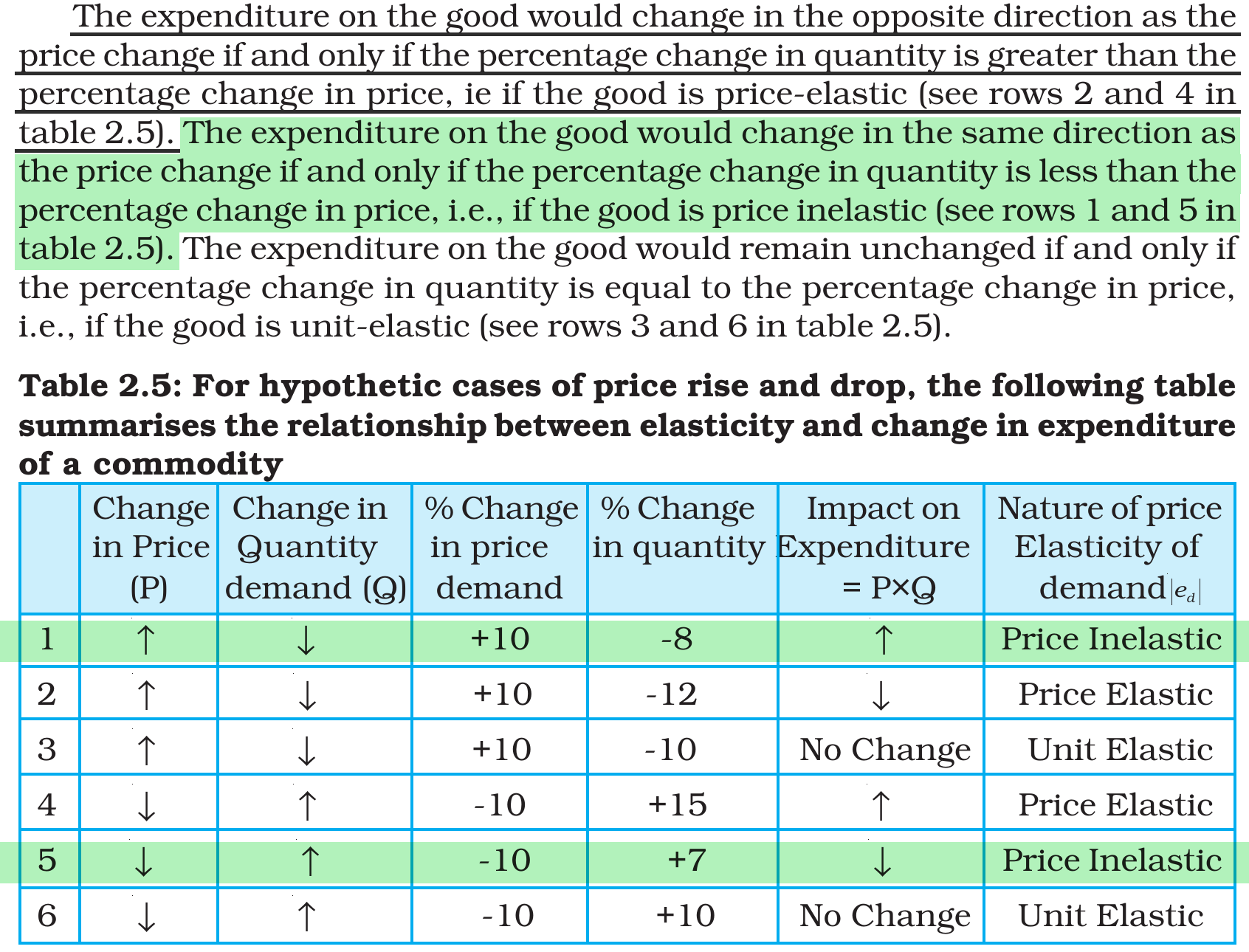
When percentage change in quantity demanded is less than the percentage change in price i.e., if the good is price inelastic, the expenditure on the good would ____________?
Identify the correct option from the following:
Answer & explanation
Correct answer: option 2
The correct answer is Option (2) → Change in same direction as the price change
Expenditure on a good is its price times the quantity bought. When demand is price inelastic, the quantity falls by a smaller percentage than the price rises. The rise in price outweighs the fall in quantity, so expenditure goes up. In the same way, a fall in price makes expenditure fall.
Option (1) Change in opposite direction as the price change — Incorrect. This happens when demand is elastic. The quantity then falls by a larger percentage than the price rises, so expenditure goes down.
Option (2) Change in same direction as the price change — Correct. With inelastic demand, expenditure rises with the price and falls with it.
Option (3) Change in reverse direction to income — Incorrect. Price elasticity links quantity to price, not to income. Income does not change here.
Option (4) Remain unchanged — Incorrect. Expenditure stays the same only when demand is unitary elastic, that is, when the quantity changes by the same percentage as the price.
NCERT (2026-27): Introductory Microeconomics — Chapter 2: Theory of Consumer Behaviour
|