
CUETMOCK
  • Pricing
  • Mentors
Log inStart freeStart free mocks→

First test, then trust

Try a free CUET mock test.

Join 5,00,000+ students who rehearsed exam day on the exact NTA screen before sitting CUET. On the web and on Android.

Start free mocks →Get the Android app
CUETMOCK

India's #1 CUET Mock Test Platform. Original NCERT-based questions on the exact NTA exam screen — trusted by 5,00,000+ students since CUET 2022.

Get it onGoogle PlayScan to download the CUETMOCK app

Mock tests

  • CUET mock test series
  • Browse all papers
  • Commerce mocks
  • Humanities (Arts) mocks
  • Science mocks
  • Languages & GAT mocks
  • Free practice questions
  • Pricing

Resources

  • CUET exam guide
  • CUET syllabus
  • Universities accepting CUET
  • Expert blogs
  • News & notifications
  • Webinars & counselling
  • CUET score calculator
  • How we estimate your rank
  • FAQs

Company

  • About us
  • Our leadership & team
  • Our toppers
  • Mentors
  • For schools
  • Contact us
  • Terms
  • Privacy
  • Refund policy

Talk to us

+91 7696 6630 56info@cuetmock.comWhatsApp us

Our other platforms

  • JEE Mock — For IIT-JEE aspirants
  • NEET Mock — For NEET aspirants

Newsletter

Exam updates, study material and offers — no spam.

© 2026 NYC Ventures Pvt. Ltd.

701-702, Royal Business Park, Zirakpur, Punjab - 140603

  • Terms of use
  • Privacy policy
  • Refund policy
  • Contact us

iCUETMOCK is an independent preparation platform, not affiliated with the National Testing Agency (NTA). Always check exam details on the official NTA website.

  • Home
  • Mock tests
  • CUET guide
  • Pricing
  • Log in
Home/Practice questions/General Aptitude Test
General Aptitude TestQuantitative ReasoningGeometry

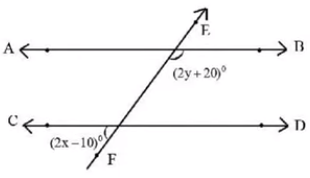
If AB || CD in the figure, then the value of x + y is:

If AB || CD in the figure, then the value of x + y is:

Answer & explanation+

Correct answer: option 2

The correct answer is Option (2) → 85°

When a transversal cuts two parallel lines, corresponding angles are equal, and two angles on a straight line (a linear pair) add up to \(180^\circ\).
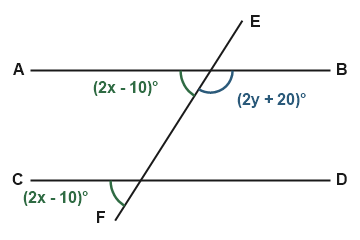
Figure for the solution

  • The angle \((2x-10)^\circ\) below CD on the left of EF has a corresponding angle below AB on the left of EF, so that angle is also \((2x-10)^\circ\)

  • At AB it forms a linear pair with \((2y+20)^\circ\): \((2x-10)+(2y+20)=180\)

  • \(2x+2y=170\)

  • \(x+y=85^\circ\)

Advertisement

Practise more on Quantitative Reasoning

Chapter-wise mocks on the real NTA exam screen, with solutions and your rank. Your first mocks are free.

Start free mocks →

Advertisement

Next questions

  1. ∫(sin 2xcos 2x)/(√(9-cos^4 2x)) dx is equal toMaths. Section B1 · Indefinite Integration
  2. Choose the most appropriate passive construction of the given sentence:The caterers had already served dinner when the guests from Lucknow…English · Grammar: Active Passive Voice
  3. ...............relationships help to maintain order in the organisation by giving the managers the right to exact obedience and give direct…Business Studies · Organising
  4. Consider the following statements regarding the network shown in the figure.(i) The equivalent resistance of the network between A and B is…Physics · Current Electricity
  5. In a race of 1 km A beats B by 170m or 17 seconds. Find the time taken by A to run 1 km?General Aptitude Test · Numerical Ability
  6. Arrange the given words in the sequence in which they occur in the dictionary and then choose the correct sequence 1. Credential 2.Creed 3.…General Aptitude Test · General Ability
  7. A short solenoid of radius a and n_1 number of turns per unit length and length L is kept coaxially inside a very long solenoid of radius b…Physics · Electromagnetic Induction
  8. Sagol Kangjei, an indigenous game of Manipur is similar to the modern day sports of:General Aptitude Test · General Knowledge
  9. The price elasticity of demand at any point on a straight line demand curve is given by the ratio of the:Economics · Micro Economics: Theory of Consumer behaviour
  10. What is the halo effect in behavioural ratings?Psychology · Self and Personality