
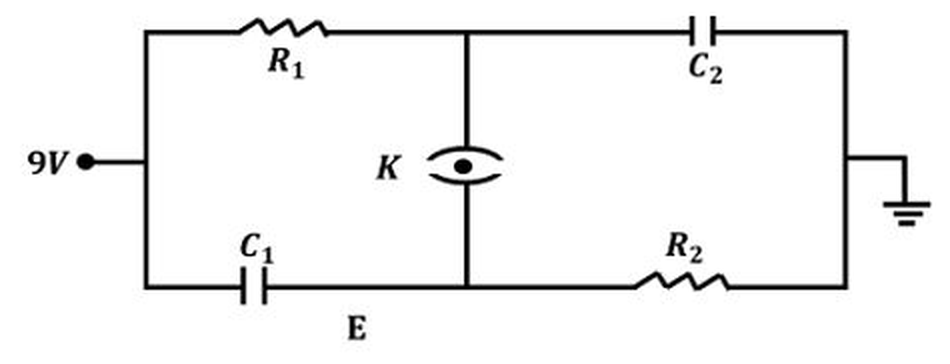
In the given circuit, \( R_1 = 6\,\Omega \), \( R_2 = 3\,\Omega \), \( C_1 = 4\,\mu\mathrm{F} \) and \( C_2 = 5\,\mu\mathrm{F} \). When key K is closed, the charge stored in \( C_1 \) is
Answer & explanation
Correct answer: option 1
The correct answer is Option (1) → \( 24\,\mu\mathrm{C} \)
In the steady state no current flows through a capacitor, so \( C_1 \) and \( C_2 \) carry no current. With the key K closed, the current flows only through the resistors: from the 9 V terminal through \( R_1 \), the key, and \( R_2 \) to the earth.
\( \displaystyle I = \frac{9\,\mathrm{V}}{R_1 + R_2} = \frac{9}{6 + 3} = 1\,\mathrm{A} \)
Take the earth as \( 0\,\mathrm{V} \). The potential of the point between the key and \( R_2 \) is the drop across \( R_2 \):
\( \displaystyle V = I R_2 = 1 \times 3 = 3\,\mathrm{V} \)
One plate of \( C_1 \) is joined directly to the 9 V terminal (no current, so no drop along that wire) and the other plate to this point at 3 V, so the potential difference across \( C_1 \) is
\( \displaystyle V_{C_1} = 9 - 3 = 6\,\mathrm{V} \)
\( \displaystyle Q_1 = C_1 V_{C_1} = 4\,\mu\mathrm{F} \times 6\,\mathrm{V} = 24\,\mu\mathrm{C} \)