By a proper choice of reagents, both symmetrical and unsymmetrical ethers can be prepared by Williamson synthesis which involves the reaction between an alkyl halide and an alkoxide ion. The reverse process involving the cleavage of ethers to give back the original alkyl halide and the alcohol can be carried out by heating the ether with HI at 373K.
Match the common names of the ethers in List-I with their IUPAC names in List-II.
| List-I (Common name) | List-II (IUPAC name) |
|---|---|
| (A) Anisole | (I) 2-Methoxypropane |
| (B) Phenetole | (II) Ethoxybenzene |
| (C) Methyl isopropyl ether | (III) 1-Methoxypropane |
| (D) Methyl n-propyl ether | (IV) Methoxybenzene |
Choose the correct answer from the options given below:
Answer & explanation
Correct answer: option 4
The correct answer is Option (4) → A-IV, B-II, C-I, D-III
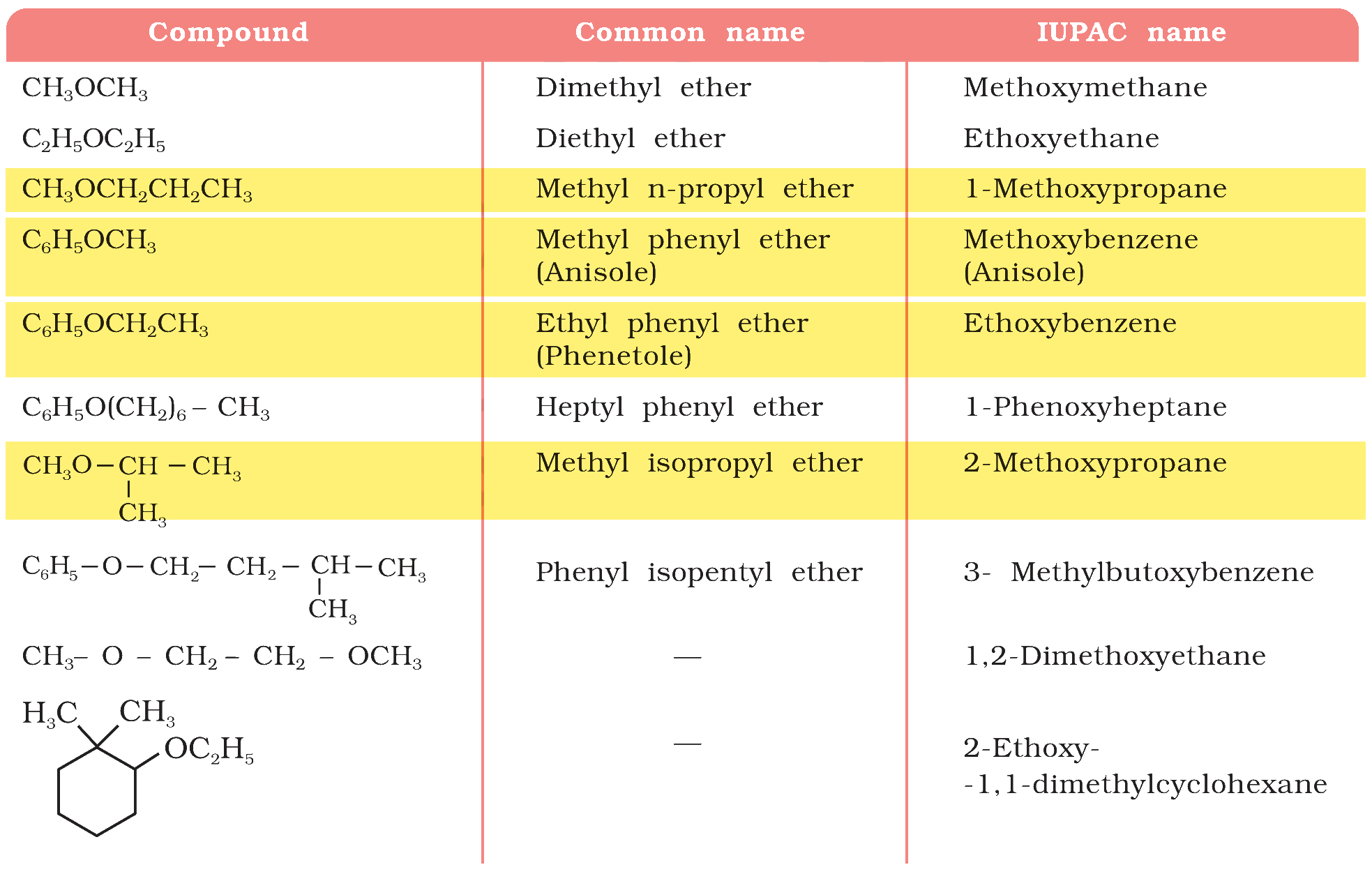
In the IUPAC system an ether is named as a hydrocarbon in which one hydrogen is replaced by an alkoxy group (–OR). The larger group is the parent hydrocarbon, and the smaller group with the oxygen becomes the alkoxy prefix (methoxy, ethoxy).
(A) Anisole — This matches (IV) Methoxybenzene. Anisole is methyl phenyl ether, C6H5OCH3: benzene is the parent and –OCH3 is the methoxy group.
(B) Phenetole — This matches (II) Ethoxybenzene. Phenetole is ethyl phenyl ether, C6H5OCH2CH3, so the group on benzene is ethoxy.
(C) Methyl isopropyl ether — This matches (I) 2-Methoxypropane. In CH3O–CH(CH3)2 the methoxy group is on the middle carbon (C-2) of the propane chain.
(D) Methyl n-propyl ether — This matches (III) 1-Methoxypropane. In CH3OCH2CH2CH3 the methoxy group is on the end carbon (C-1) of the chain.
NCERT (2026-27 edition):
7.2 Nomenclature – “(c) Ethers: Common names of ethers are derived from the names of alkyl/ aryl groups written as separate words in alphabetical order and adding the word ‘ether’ at the end.”
“According to IUPAC system of nomenclature, ethers are regarded as hydrocarbon derivatives in which a hydrogen atom is replaced by an –OR or –OAr group, where R and Ar represent alkyl and aryl groups, respectively. The larger (R) group is chosen as the parent hydrocarbon. The names of a few ethers are given as examples in Table 7.2.”
Table 7.2: Common and IUPAC Names of Some Ethers