
The standard electrode potential for the Daniell cell is 1.1 V. The standard Gibbs energy for the given below reaction will be:
Zn (s) + Cu2+ (aq.) → Zn2+ (aq.) + Cu (s)
Answer & explanation
Correct answer: option 1
The correct answer is Option (1) → –212.3 kJ/mol
A galvanic cell does electrical work at the cost of the reaction’s Gibbs energy. For n moles of electrons passing through a cell of standard emf E°cell:
\( \displaystyle \Delta_rG^{\circ}=-nFE^{\circ}_{cell} \)
A positive E°cell gives a negative ΔG°, which means the cell reaction is spontaneous.
For the Daniell cell:
\( \displaystyle \ce{Zn(s) + Cu^2+(aq) -> Zn^2+(aq) + Cu(s)} \)
Anode: \( \ce{Zn(s) -> Zn^2+(aq) + 2e^-} \); cathode: \( \ce{Cu^2+(aq) + 2e^- -> Cu(s)} \); so n = 2.
E°cell = E°cathode − E°anode = 0.34 − (−0.76) = 1.10 V.
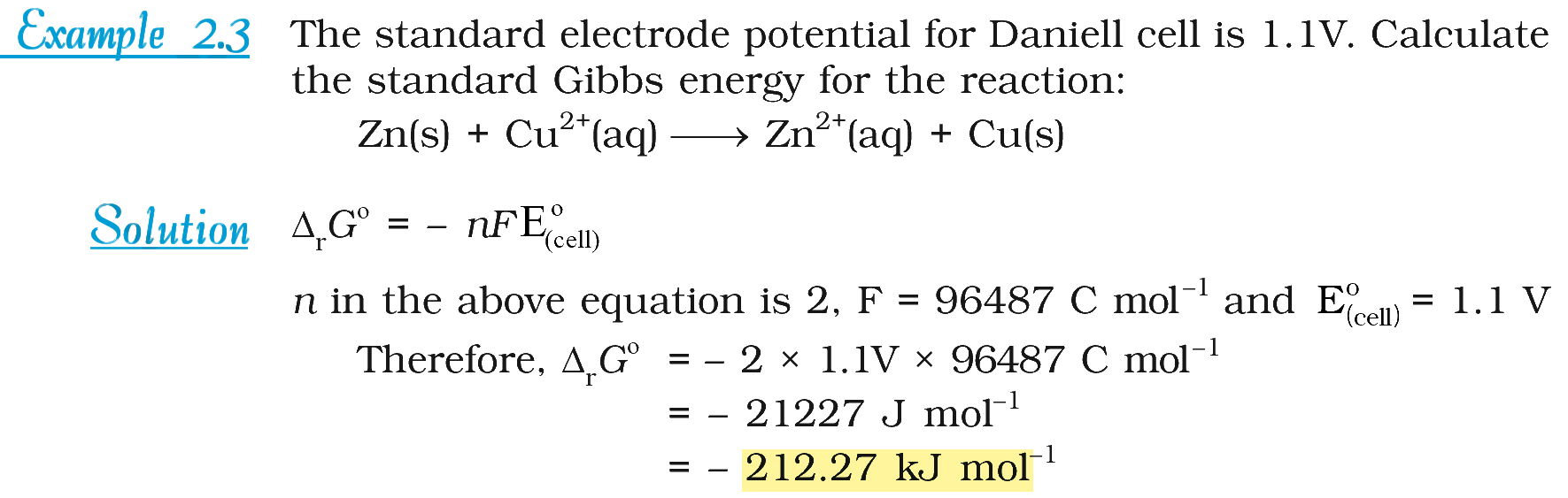
\( \displaystyle \Delta_rG^{\circ}=-2\times96500\ \mathrm{C\,mol^{-1}}\times1.10\ \mathrm{V} \)
\( \displaystyle \Delta_rG^{\circ}=-212300\ \mathrm{J\,mol^{-1}} \)
\( \displaystyle \Delta_rG^{\circ}=-212.3\ \mathrm{kJ\,mol^{-1}} \)
Shortcut: 2 × 96500 × 1.1 ≈ 212000 J, which is about 212 kJ. Only Options (1) and (2) show 212.3, and only Option (1) has it in kJ/mol.
Note 1: In the book’s working (extract below), the value in joules is printed as −21227 J mol−1; it should be −212270 J mol−1, which is the −212.27 kJ mol−1 given on the next line.
Note 2: This question is from NCERT (2026-27). NTA sets numerical questions from NCERT too, so do not ignore NCERT while practising numericals.
NCERT (2026-27 edition):
Electrochemical Cell and Gibbs Energy of the Reaction – …
Note 3: The same/similar question has been asked in different years by NTA as per the details given below:
| 2026 | 2025 | 2024 | 2023 | 2022 |
|---|---|---|---|---|
| 30-05 S1 29-05 S2 29-05 S1 11-05 S1 | 29-05 S1 26-05 S2 | 19-07 S1 | 22-06 S3 12-06 S3 | – |