
Case: Read the passage and answer the question.
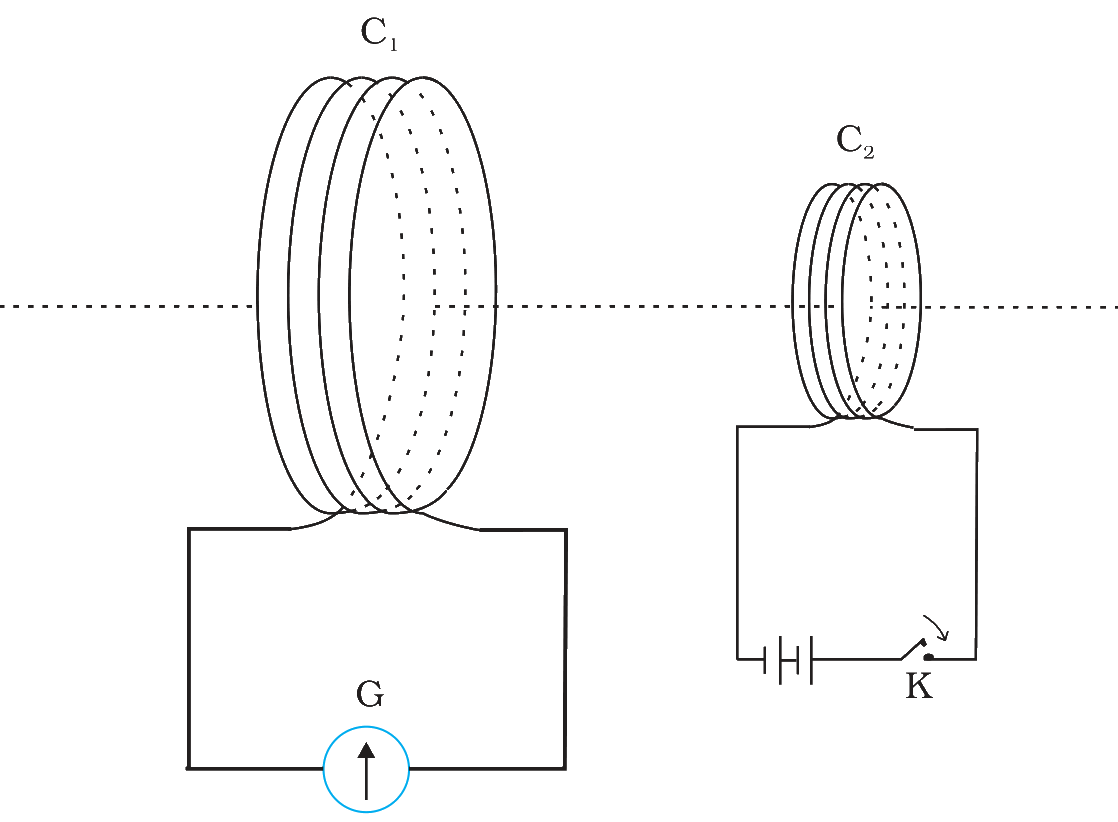
Consider a coil C1 connected to a galvanometer G, as shown. Another coil C2, connected to a battery through a tapping key K, is placed next to the first coil.
The magnetic flux \( \Phi_B \) through a plane area A placed in a uniform magnetic field \( \vec{B} \) is (\( \vec{A} \) is the area vector and \( \theta \) the angle between \( \vec{B} \) and \( \vec{A} \))
Answer & explanation
Correct answer: option 3
The correct answer is Option (3) → \( BA\cos\theta \)
Magnetic flux through a plane area in a uniform field is the scalar (dot) product of the field and the area vector:
\( \begin{aligned} \Phi_B &= \vec{B}\cdot\vec{A} \\ &= BA\cos\theta \end{aligned} \)
Option (1) \( \vec{B}\times\vec{A} \) — Incorrect. A cross product of two vectors is a vector, while magnetic flux is a scalar.
Option (2) \( \vec{A}\times\vec{B} \) — Incorrect. This is also a vector, equal to \( -\vec{B}\times\vec{A} \), so it cannot be the flux.
Option (3) \( BA\cos\theta \) — Correct. The dot product gives the largest flux, \( BA \), when the field is along the area vector (\( \theta=0^\circ \)), that is, normal to the plane. It gives zero flux when the field lies in the plane (\( \theta=90^\circ \)).
Option (4) \( BA\sin\theta \) — Incorrect. It would give zero flux when the field is normal to the plane. But the flux is largest there. \( BA\sin\theta \) is the magnitude of the cross product.
NCERT (2026-27):
Magnetic Flux – “… Magnetic flux through a plane of area A placed in a uniform magnetic field B … can be written as
\( \Phi_B=\vec{B}\cdot\vec{A}=BA\cos\theta \)\( \qquad (6.1) \)
where θ is angle between B and A.”