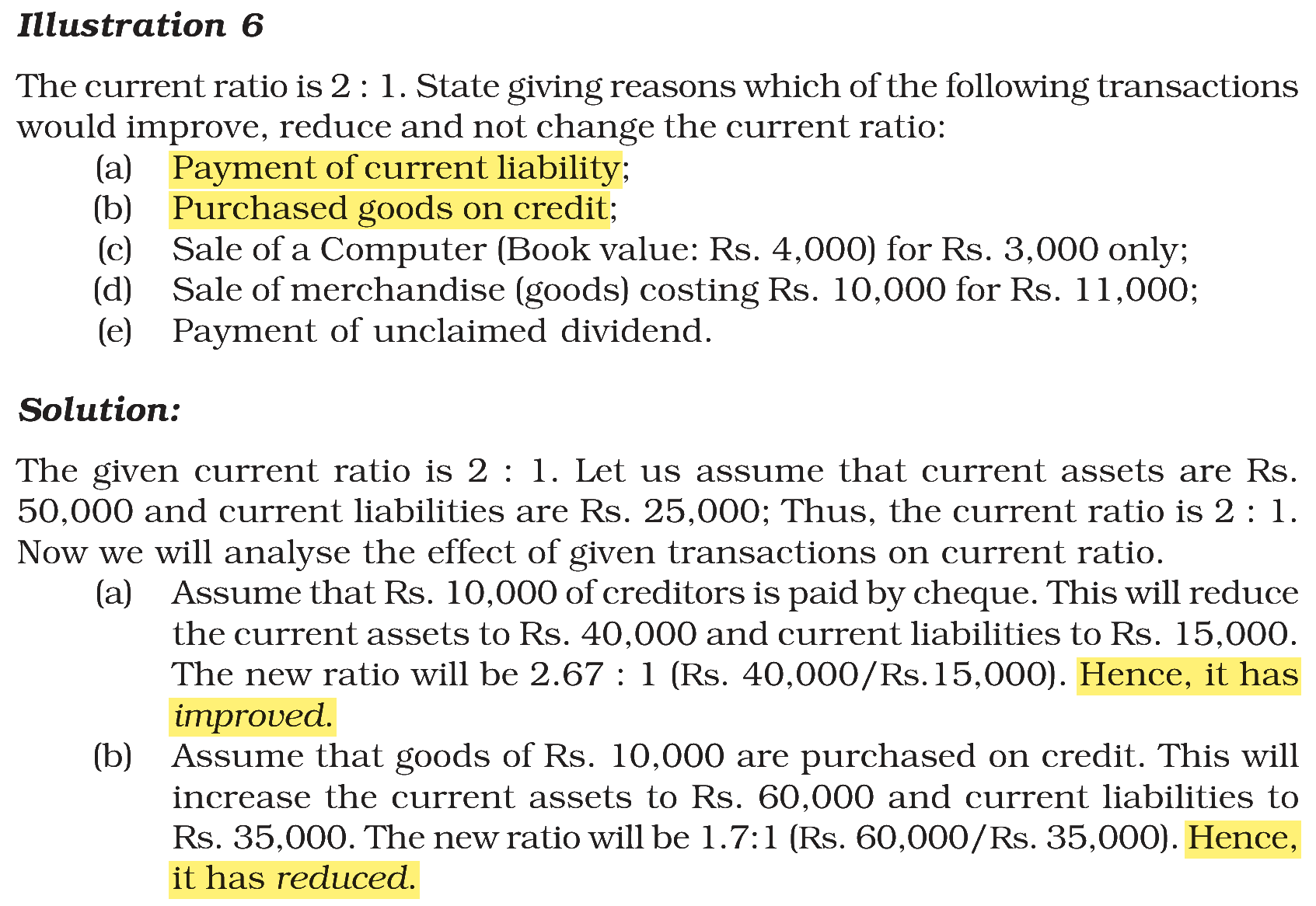
The current ratio is 2 : 1. Identify which of the following transactions would improve, reduce and not change the current ratio. Match the LIST-I with LIST-II
| LIST-I | LIST-II | ||
|---|---|---|---|
| A. | Payment of current liability | I. | Current ratio will reduce |
| B. | Sold goods on credit | II. | Current ratio will improve |
| C. | Purchased goods on credit | III. | No change in current ratio |
Choose the correct answer from the options given below:
Answer & explanation
Correct answer: option 4
The correct answer is Option (4) → A-II, B-III, C-I
Take a current ratio of 2 : 1 with current assets of Rs. 50,000 and current liabilities of Rs. 25,000. A transaction that takes the same amount off both sides pushes the ratio up, and one that adds the same amount to both sides pulls it down towards 1.
(A) Payment of current liability — this matches (II) Current ratio will improve. Paying Rs. 10,000 of creditors reduces both sides.
Current assets = Rs. 40,000; current liabilities = Rs. 15,000
New ratio = about 2.67 : 1
(B) Sold goods on credit — this matches (III) No change in current ratio. If the goods are sold at cost, stock is replaced by debtors of the same amount, so current assets and current liabilities stay as they were.
(C) Purchased goods on credit — this matches (I) Current ratio will reduce. Stock and creditors both rise by Rs. 10,000.
Current assets = Rs. 60,000; current liabilities = Rs. 35,000
New ratio = about 1.71 : 1
Note: (B) Sold goods on credit can also be matched with (II) Current ratio will improve, because goods sold at a profit would raise current assets a little; but then (A) and (B) would both be ‘improve’, which no option offers, so the answer given by NTA follows the sale at cost used above.
NCERT (2026-27 edition):
|