The following statements are about Indian modern artists and their works.
(A) Amrita Sher-Gil’s Haldi Grinder depicts Indian women busy grinding dry turmeric.
(B) Biren De’s move towards Indian abstract art led to captivating experiments with colours and patterns.
(C) In Haldi Grinder, Sher-Gil created shapes of figures by outline and not by colour contrast.
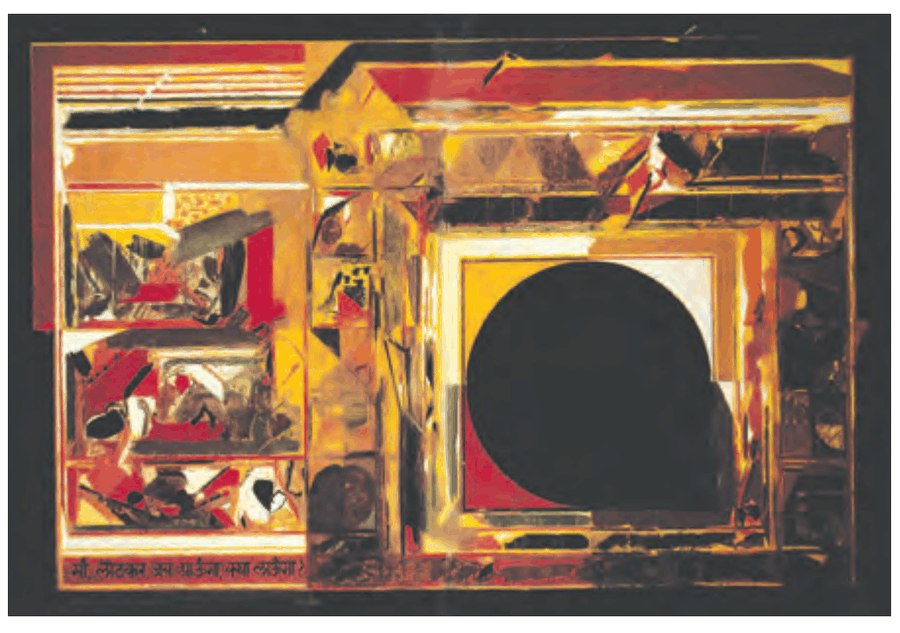
(D) Ma is a painting by S. H. Raza.
Choose the correct answer from the options given below:
Answer & explanation
Correct answer: option 2
The correct answer is Option (2) → (A), (B) and (D) only
(A) Amrita Sher-Gil’s Haldi Grinder depicts Indian women busy grinding dry turmeric. — Correct. The scene shows a traditional activity of rural India, painted in Indian style.
(B) Biren De’s move towards Indian abstract art led to captivating experiments with colours and patterns. — Correct. Biren De was one of the artists who turned to the past and local traditions in the 1960s.
(C) In Haldi Grinder, Sher-Gil created shapes of figures by outline and not by colour contrast. — Incorrect. It is the reverse: she made the figures by colour contrast and not outline, with bright colour patches close to each other.
(D) Ma is a painting by S. H. Raza. — Correct. Ma (1972) is a work of S. H. Raza, who moved towards abstraction.
Note: This topic was not named in the CUET 2026 syllabus, but it was part of the NCERT chapter. In 2025 and 2026, NTA also asked questions on topics in NCERT that the CUET syllabus did not name. So our mocks have questions from every part of the NCERT chapter, to give you enough practice. Read the whole chapter, not only the sub-topics named in the syllabus.
NCERT (2026-27): “Haldi Grinder Amrita Sher-Gil painted Haldi Grinder in 1940. This was the time when she was seeking inspiration from India’s idyllic rural scene. Such a scene, depicting Indian women busy in a traditional activity of grinding dry turmeric, had to be painted in Indian style. … This is evident in the way she has placed bright colour patches close to each other and created shapes of figures by colour contrast and not outline.” “Abstraction – A New Trend …Many Indian artists and critics grew worried about their imitation of modern art from the West and felt the need to establish an Indian identity in their art. In the 1960s, Biren De and G. R. Santosh in Delhi and K. C. S. Paniker in Madras moved in this direction when they turned to the past and local artistic traditions to create a unique Indian abstract art. … In Biren De’s works, this move led to captivating experiments with colours and patterns.”
S. H. Raza, Ma, 1972. Bombay, India |