
The figure shows two coils C1 and C2 held at rest. C1 is joined to a galvanometer G. C2 is joined to a battery through a tapping key K.
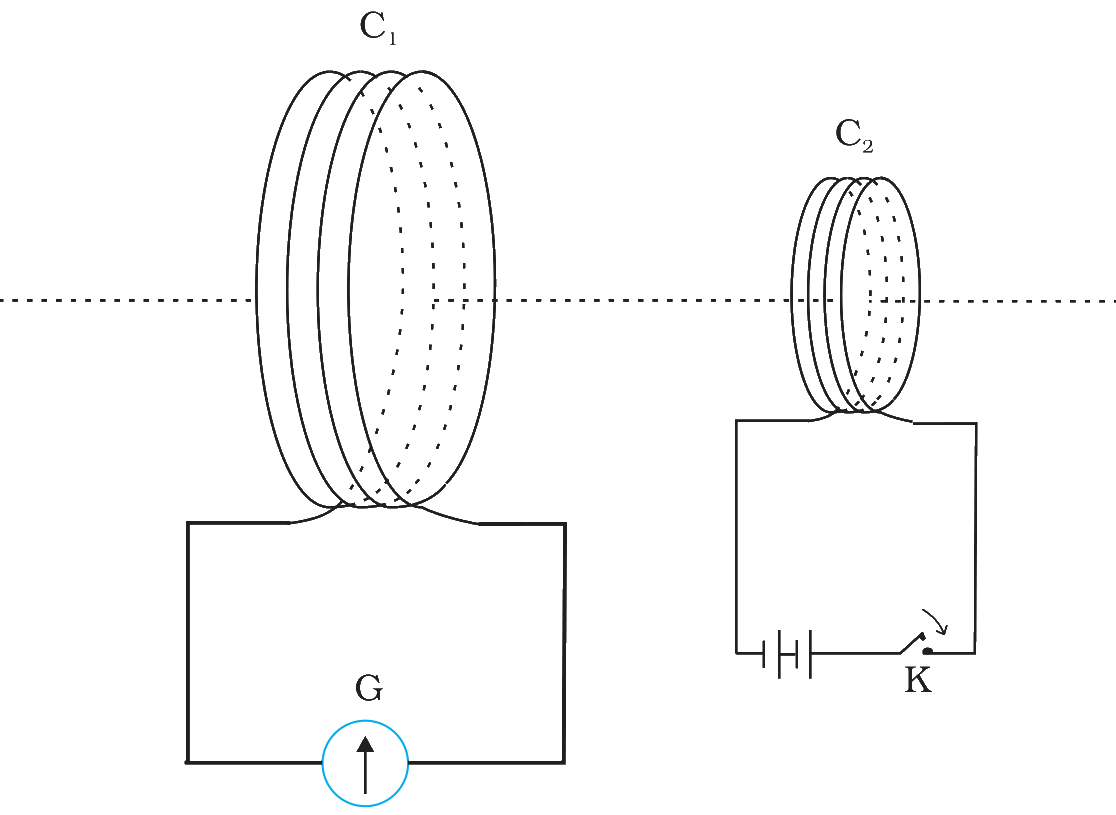
The galvanometer shows a deflection when K is pressed. Which of the following conclusions follows from this observation?
Answer & explanation
Correct answer: option 4
The correct answer is Option (4) → A changing current in one coil can induce a current in a nearby coil.
When K is pressed, the current in C2 rises from zero in a short time. So the magnetic flux through C1 also rises. This change of flux induces an emf in C1, and a current flows through G.
Option (1) Relative motion between the two coils is needed to induce a current. — Incorrect. Both coils are held at rest in this set-up. Still, the galvanometer deflects, so no relative motion is needed here.
Option (2) A steady current in C2 keeps a steady current flowing in C1. — Incorrect. While K stays pressed, the current in C2 is steady. The flux through C1 does not change, so the pointer returns to zero.
Option (3) An iron rod inside the coils is needed for a current to be induced in C1. — Incorrect. There is no iron rod in this set-up, yet G deflects. An iron rod along the axis only makes the deflection much larger.
Option (4) A changing current in one coil can induce a current in a nearby coil. — Correct. Pressing K changes the current in C2. This changes the flux through C1 and induces a current in it, though neither coil moves.
NCERT (2026-27):
The Experiments of Faraday and Henry – “… Through another experiment, Faraday showed that this relative motion is not an absolute requirement. …”
Faraday’s Law of Induction – “… It is the change in magnetic flux through coil C1 that produces an induced emf in coil C1. …”
FIGURE 6.3 Experimental set-up for Experiment 6.3.