
CUETMOCK
  • Pricing
  • Mentors
Log inStart freeStart free mocks→

First test, then trust

Try a free CUET mock test.

Join 5,00,000+ students who rehearsed exam day on the exact NTA screen before sitting CUET. On the web and on Android.

Start free mocks →Get the Android app
CUETMOCK

India's #1 CUET Mock Test Platform. Original NCERT-based questions on the exact NTA exam screen — trusted by 5,00,000+ students since CUET 2022.

Get it onGoogle PlayScan to download the CUETMOCK app

Mock tests

  • CUET mock test series
  • Browse all papers
  • Commerce mocks
  • Humanities (Arts) mocks
  • Science mocks
  • Languages & GAT mocks
  • Free practice questions
  • Pricing

Resources

  • CUET exam guide
  • CUET syllabus
  • Universities accepting CUET
  • Expert blogs
  • News & notifications
  • Webinars & counselling
  • CUET score calculator
  • How we estimate your rank
  • FAQs

Company

  • About us
  • Our leadership & team
  • Our toppers
  • Mentors
  • For schools
  • Contact us
  • Terms
  • Privacy
  • Refund policy

Talk to us

+91 7696 6630 56info@cuetmock.comWhatsApp us

Our other platforms

  • JEE Mock — For IIT-JEE aspirants
  • NEET Mock — For NEET aspirants

Newsletter

Exam updates, study material and offers — no spam.

© 2026 NYC Ventures Pvt. Ltd.

701-702, Royal Business Park, Zirakpur, Punjab - 140603

  • Terms of use
  • Privacy policy
  • Refund policy
  • Contact us

iCUETMOCK is an independent preparation platform, not affiliated with the National Testing Agency (NTA). Always check exam details on the official NTA website.

  • Home
  • Mock tests
  • CUET guide
  • Pricing
  • Log in
Home/Practice questions/Biology
BiologyBiomolecules

Match the following secondary metabolites with their respective examp…

Match the following secondary metabolites with their respective examples:

Column I Column II
A. Pigments I. Vinblastin
B. Alkaloids II. Ricin
C. Toxins III. Morphine
D. Drugs IV. Anthocyanins


Answer & explanation+

Correct answer: option 4

The correct answer is Option (4) - A-IV, B-III, C-II, D-I

Column I Column II
A. Pigments IV. Anthocyanins
B. Alkaloids III. Morphine
C. Toxins II. Ricin
D. Drugs I. Vinblastin

Secondary metabolites are organic compounds that are generally produced by plants, bacteria and fungi. These compounds are not directly involved in physiological processes like growth and development.
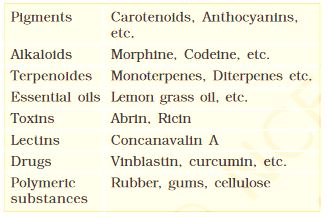
        Some Secondary Metabolites

Advertisement

Practise more on Biomolecules

Chapter-wise mocks on the real NTA exam screen, with solutions and your rank. Your first mocks are free.

Start free mocks →

Advertisement

Next questions

  1. Select the option that expresses the given sentence in indirect speech. He said to me, "Do you own this beautiful car?"English · Direct/indirect
  2. Which of the following is NOT a fundamental right of Indian citizens?General Aptitude Test · General Knowledge
  3. Which of the following Article of the Constitution deals with abolition of Untouchability?Legal Studies · Human Rights in India
  4. Many areas of Meghalaya, Uttarakhand, Himachal Pradesh and Kerala have _____ type of settlements.Geography · India-People and Economy: Human Settlements
  5. Consider the following statements about the individual labour supply curve:(A) At low wage rates, the opportunity-cost effect of a wage ris…Economics · Micro Economics: Market Equilibrium
  6. The current in a solenoid changes from 0.0A to 10.0A in 0.1 sec. If an average emf of 2V is induced in the circuit, the value of self-induc…Physics · Electromagnetic Induction
  7. Bar graph shows the number of males and females in five organizations A, B, C, D and E. What is the ratio of number of males working in org…General Aptitude Test · Quantitative Reasoning
  8. Carl Rogers' client-centred therapy emphasises which of the following?Psychology · Therapeutic Approaches
  9. A letter series is given below in which some letters are missing. Select the option that gives the letters that can fill these blanks in th…General Aptitude Test · General Ability
  10. The drift velocity of electrons is 2 × 10^-6 m/s in a conductor in which the number of free electrons is 6 × 10^28 per m^3 . If the cross s…Physics · Current Electricity