Identify "Y" in the following reaction:

Answer & explanation
Correct answer: option 3
The correct answer is Option (3) → \(ROH\)
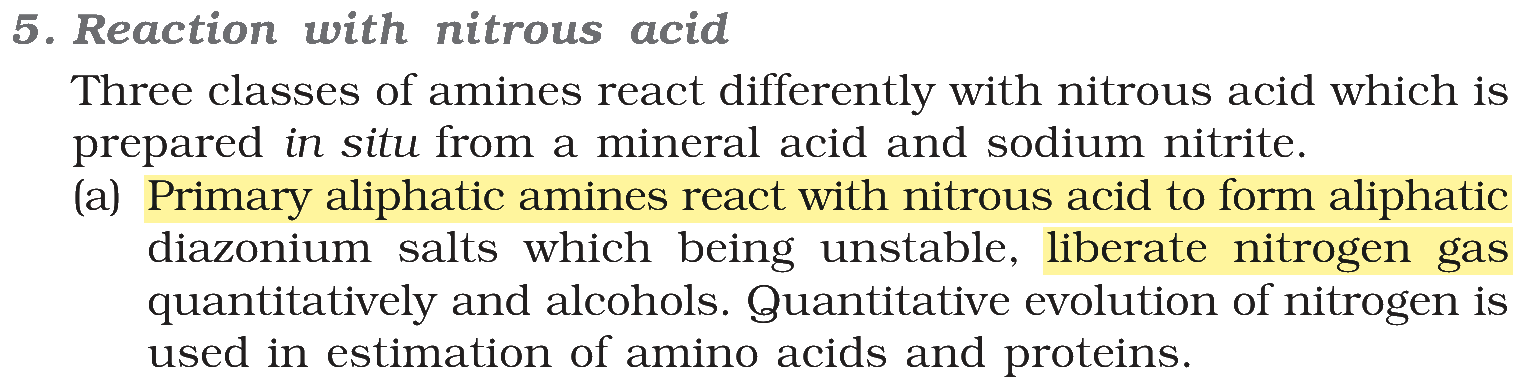
Nitrous acid is unstable, so it is made in the reaction mixture from sodium nitrite and hydrochloric acid:
\( \displaystyle \ce{NaNO2 + HCl -> HNO2 + NaCl} \)
A primary aliphatic amine gives an aliphatic diazonium salt (X), which decomposes in water to an alcohol (Y):
\( \displaystyle \ce{R-NH2 + HNO2} \xrightarrow{\ce{NaNO2 + HCl}} \ce{R-N2^+Cl^-}\ (\text{X}) \)
\( \displaystyle \ce{R-N2^+Cl^-} \xrightarrow{\ce{H2O}} \ce{ROH}\ (\text{Y}) + \ce{N2 ^} + \ce{HCl} \)
So Y is the alcohol, ROH.
Why the other options are incorrect
Option (1) \(R-CONH_2\) — Incorrect. An amide needs a C=O group next to nitrogen; here the nitrogen leaves the molecule altogether as \( \ce{N2} \).
Option (2) \(R-COCl\) — Incorrect. An acid chloride is made from a carboxylic acid with \( \ce{SOCl2} \) or \( \ce{PCl5} \); it cannot form from an amine and nitrous acid.
Option (4) \(R-NO_2\) — Incorrect. A nitroalkane would keep the nitrogen; it is made from an alkyl halide and silver nitrite, not by diazotisation.
NCERT (2026-27 edition):
Reaction with Nitrous Acid