
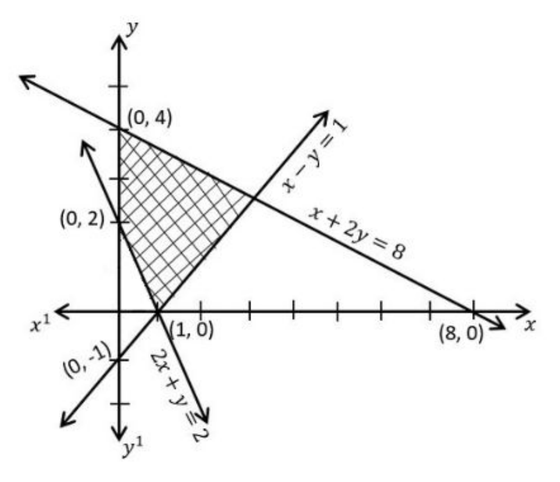
The linear inequalities satisfying the shaded feasible region given in the figure are
(A) \(x \ge 0,\quad y \ge 0,\quad 2x + y \ge 2\)
(B) \(x \ge 0,\quad y \ge 0,\quad 2x + y \le 2\)
(C) \(x \ge 0,\quad y \ge 0,\quad 2x + y \ge 2,\quad x + 2y \le 8,\quad x - y \le 1\)
(D) \(x + 2y \ge 8,\quad x - y \ge 1\)
Choose the correct answer from the options given below:
Answer & explanation
Correct answer: option 1
The correct answer is Option (1) → (A) and (C) only
The lines in the figure, through their marked points:
\(2x + y = 2\): (1, 0) and (0, 2)
\(x - y = 1\): (1, 0) and (0, −1)
\(x + 2y = 8\): (8, 0) and (0, 4)
The lines \(x - y = 1\) and \(x + 2y = 8\) meet where \(x = y + 1\):
\(3y + 1 = 8,\quad y = \frac{7}{3},\quad x = \frac{10}{3}\)
The shaded region is the quadrilateral with corners (0, 2), (1, 0), \(\left(\frac{10}{3}, \frac{7}{3}\right)\) and (0, 4). By the origin test, it lies on the far side of \(2x + y = 2\) from the origin (\(2x + y \ge 2\)) and on the origin side of \(x - y = 1\) and \(x + 2y = 8\) (\(x - y \le 1\), \(x + 2y \le 8\)).
A set of inequalities is taken to “satisfy” the region when every point of the shaded region satisfies all of them; a linear inequality holds on the whole region if it holds at all four corners.
So the shaded region is exactly \(x \ge 0, y \ge 0, 2x + y \ge 2, x + 2y \le 8, x - y \le 1\).
Checking the statements
(A) \(x \ge 0, y \ge 0, 2x + y \ge 2\) — Correct. All three are among the region’s constraints, so every point of the region satisfies them.
(B) \(x \ge 0, y \ge 0, 2x + y \le 2\) — Incorrect. At the corner (0, 4), \(2x + y = 4 \gt 2\).
(C) \(x \ge 0, y \ge 0, 2x + y \ge 2, x + 2y \le 8, x - y \le 1\) — Correct. These are exactly the constraints of the shaded region.
(D) \(x + 2y \ge 8, x - y \ge 1\) — Incorrect. At the corner (0, 2), \(x + 2y = 4 \lt 8\).