One category where people are always or usually poor but who may sometimes have a little more money are grouped together as :
Answer & explanation
Correct answer: option 1
The correct answer is Option (1) → Chronic Poor
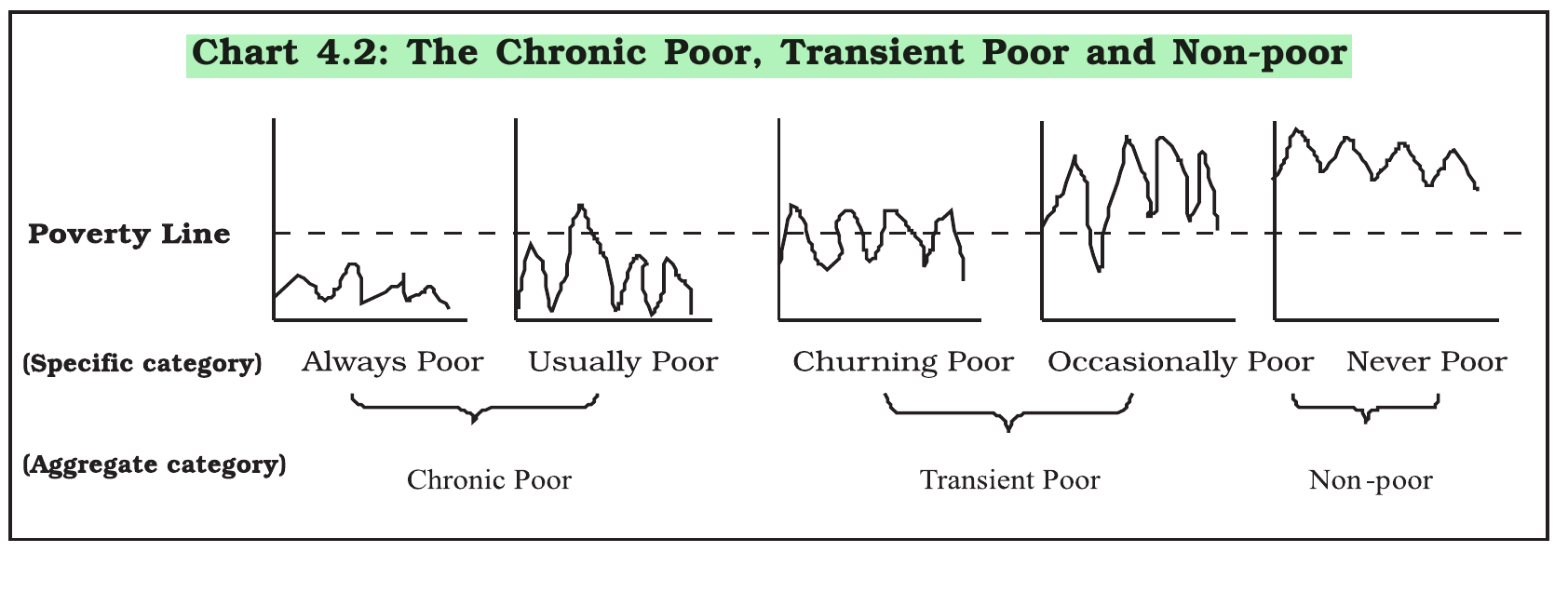
People who are always poor, and those who are usually poor but sometimes have a little more money, form one group. This group is the chronic poor. Casual workers are an example.
Option (1) Chronic Poor — Correct. This group is poor nearly all the time, and a little extra money now and then does not change that.
Option (2) Transient Poor — Incorrect. This group covers the churning poor and the occasionally poor. The occasionally poor are rich most of the time and may sometimes have a patch of bad luck.
Option (3) Non Poor — Incorrect. These people are never poor.
Option (4) Churning Poor — Incorrect. These people regularly move in and out of poverty. Small farmers and seasonal workers are examples.
Note: This question is taken from the chapter ‘Poverty’ which was there in the pre-rationalised NCERT and has been deleted from subsequent editions of NCERT, including the NCERT book (2026-27). The chapter was also not in the CUET (UG) 2026 syllabus.
NCERT (Pre-rationalised): “4.3 How are Poor People Identified? … Categorising Poverty: There are many ways to categorise poverty. In one such way people who are always poor and those who are usually poor but who may sometimes have a little more money (example: casual workers) are grouped together as the chronic poor. Another group are the churning poor who regularly move in and out of poverty (example: small farmers and seasonal workers) and the occasionally poor who are rich most of the time but may sometimes have a patch of bad luck. They are called the transient poor. And then, there are those who are never poor and they are the non-poor (Chart 4.2).…”
|