CUETMOCK
  • Pricing
  • Mentors
Log inStart freeStart free mocks→

First test, then trust

Try a free CUET mock test.

Join 5,00,000+ students who rehearsed exam day on the exact NTA screen before sitting CUET. On the web and on Android.

Start free mocks →Get the Android app
CUETMOCK

India's #1 CUET Mock Test Platform. Original NCERT-based questions on the exact NTA exam screen — trusted by 5,00,000+ students since CUET 2022.

Get it onGoogle PlayScan to download the CUETMOCK app

Mock tests

  • CUET mock test series
  • Browse all papers
  • Commerce mocks
  • Humanities (Arts) mocks
  • Science mocks
  • Languages & GAT mocks
  • Free practice questions
  • Pricing

Resources

  • CUET exam guide
  • CUET syllabus
  • Universities accepting CUET
  • Expert blogs
  • News & notifications
  • Webinars & counselling
  • CUET score calculator
  • How we estimate your rank
  • FAQs

Company

  • About us
  • Our leadership & team
  • Our toppers
  • Mentors
  • For schools
  • Contact us
  • Terms
  • Privacy
  • Refund policy

Talk to us

+91 7696 6630 56info@cuetmock.comWhatsApp us

Our other platforms

  • JEE Mock — For IIT-JEE aspirants
  • NEET Mock — For NEET aspirants

Newsletter

Exam updates, study material and offers — no spam.

© 2026 NYC Ventures Pvt. Ltd.

701-702, Royal Business Park, Zirakpur, Punjab - 140603

  • Terms of use
  • Privacy policy
  • Refund policy
  • Contact us

iCUETMOCK is an independent preparation platform, not affiliated with the National Testing Agency (NTA). Always check exam details on the official NTA website.

  • Home
  • Mock tests
  • CUET guide
  • Pricing
  • Log in
Home/Practice questions/History
HistoryMedieval India: Bhakti Sufi Traditions

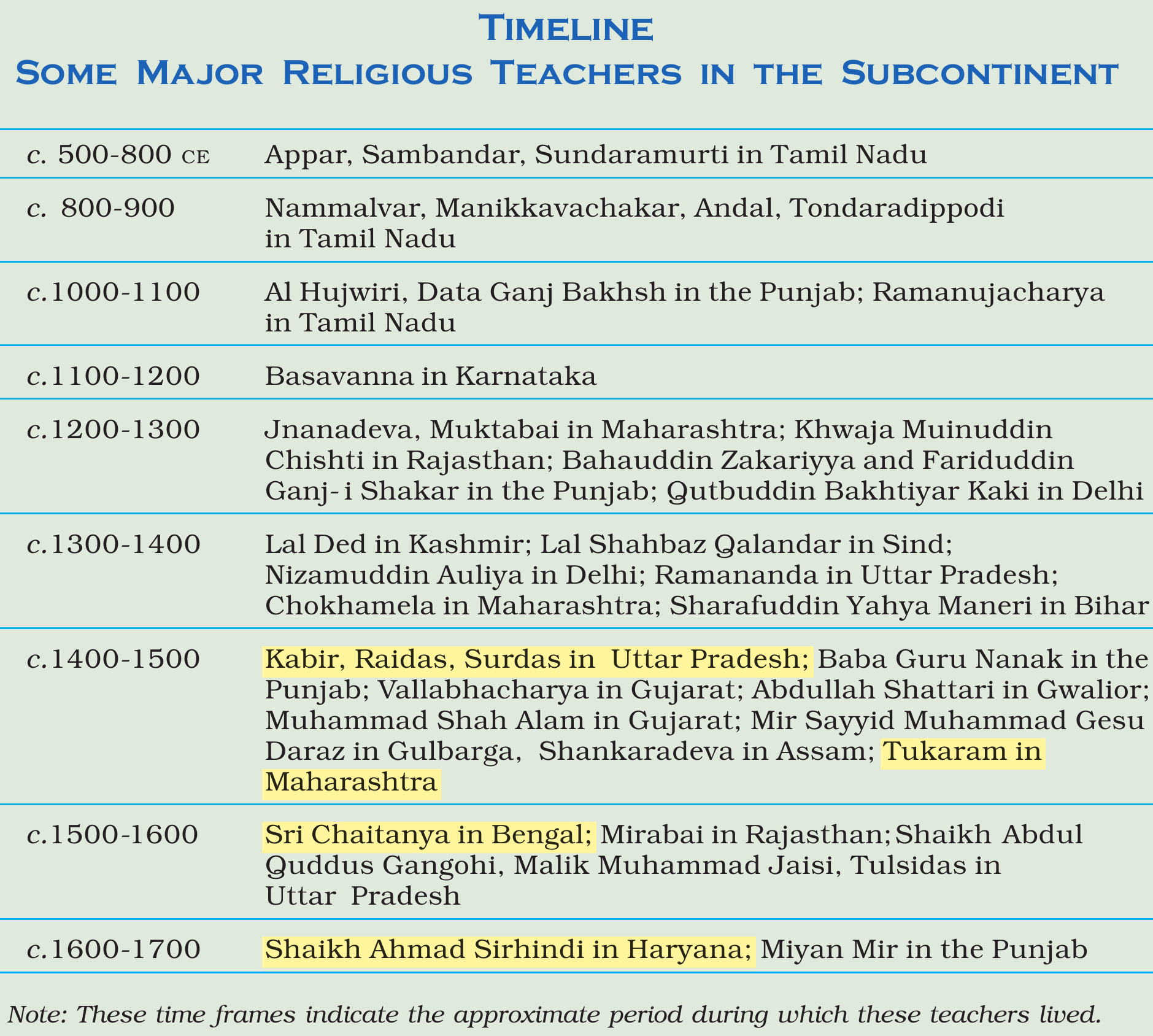
Match List-I with List-II:List-IReligious TeachersList-IIPlace(A)Kabi…

Match List-I with List-II:

List-I
Religious Teachers
List-II
Place
(A)Kabir(I)Maharashtra
(B)Tukaram(II)Bengal
(C)Chaitanya(III)Haryana
(D)Shaikh Ahmad Sirhindi(IV)Uttar Pradesh

Choose the correct answer from the options given below:

Answer & explanation+

Correct answer: option 4

The correct answer is Option (4) → (A)-(IV), (B)-(I), (C)-(II), (D)-(III)

(A) Kabir — this matches (IV) Uttar Pradesh. Kabir is placed in Uttar Pradesh in c. 1400-1500, with Raidas and Surdas.

(B) Tukaram — this matches (I) Maharashtra. Tukaram is a religious teacher of Maharashtra.

(C) Chaitanya — this matches (II) Bengal. Sri Chaitanya is placed in Bengal in c. 1500-1600.

(D) Shaikh Ahmad Sirhindi — this matches (III) Haryana. Shaikh Ahmad Sirhindi is placed in Haryana in c. 1600-1700.


NCERT: Themes in Indian History Part II — Chapter 6: Bhakti-Sufi Traditions (2026-27)

NCERT extract

Advertisement

Practise more on Medieval India: Bhakti Sufi Traditions

Chapter-wise mocks on the real NTA exam screen, with solutions and your rank. Your first mocks are free.

Start free mocks →

Advertisement

Next questions

  1. If x+ 1/15x = 3 find 1/2 (9x3 + frac1375x^3 ).General Aptitude Test · Quantitative Reasoning
  2. One mole of an ideal gas occupies a volume of _________ litre at 273 K and 1 atm pressure.General Aptitude Test · General Knowledge
  3. Why were some economists critical of the performance of many public sector enterprises?Economics · Indian Economic Development: Indian Economy:1950-1990
  4. 44% of a number is 2288. What will be 87% of the number?General Aptitude Test · Numerical Ability
  5. Calculate the Unit Cost if the variable cost is 60% of the sale price?Entrepreneurship · Business Arithmetic
  6. A solenoid of length 0.4 m, radius of 1 cm and 400 turns carries a current of 2 A. The magnetic field produced inside the solenoid is:Physics · Moving Charges and Magnetism
  7. Which of the following is true for Maxwell Boltzmann distribution curve?Chemistry · Physical: Chemical Kinetics
  8. Anthrax is caused by :General Aptitude Test · General Knowledge
  9. Marketer refers to any person who takes more _____ part in the process of exchange.Business Studies · Marketing
  10. The railways are the most preferred means of transport for _________.Geography · Fundamentals of Human Geography: Transport and Communication