CUETMOCK
  • Pricing
  • Mentors
Log inStart freeStart free mocks→

First test, then trust

Try a free CUET mock test.

Join 5,00,000+ students who rehearsed exam day on the exact NTA screen before sitting CUET. On the web and on Android.

Start free mocks →Get the Android app
CUETMOCK

India's #1 CUET Mock Test Platform. Original NCERT-based questions on the exact NTA exam screen — trusted by 5,00,000+ students since CUET 2022.

Get it onGoogle PlayScan to download the CUETMOCK app

Mock tests

  • CUET mock test series
  • Browse all papers
  • Commerce mocks
  • Humanities (Arts) mocks
  • Science mocks
  • Languages & GAT mocks
  • Free practice questions
  • Pricing

Resources

  • CUET exam guide
  • CUET syllabus
  • Universities accepting CUET
  • Expert blogs
  • News & notifications
  • Webinars & counselling
  • CUET score calculator
  • How we estimate your rank
  • FAQs

Company

  • About us
  • Our leadership & team
  • Our toppers
  • Mentors
  • For schools
  • Contact us
  • Terms
  • Privacy
  • Refund policy

Talk to us

+91 7696 6630 56info@cuetmock.comWhatsApp us

Our other platforms

  • JEE Mock — For IIT-JEE aspirants
  • NEET Mock — For NEET aspirants

Newsletter

Exam updates, study material and offers — no spam.

© 2026 NYC Ventures Pvt. Ltd.

701-702, Royal Business Park, Zirakpur, Punjab - 140603

  • Terms of use
  • Privacy policy
  • Refund policy
  • Contact us

iCUETMOCK is an independent preparation platform, not affiliated with the National Testing Agency (NTA). Always check exam details on the official NTA website.

  • Home
  • Mock tests
  • CUET guide
  • Pricing
  • Log in
Home/Practice questions/Psychology
PsychologyVariations in Psychological Attributes

Match List-I with List-IIList-IList-II(A)Specifies the behaviors cons…

Match List-I with List-II

List-IList-II
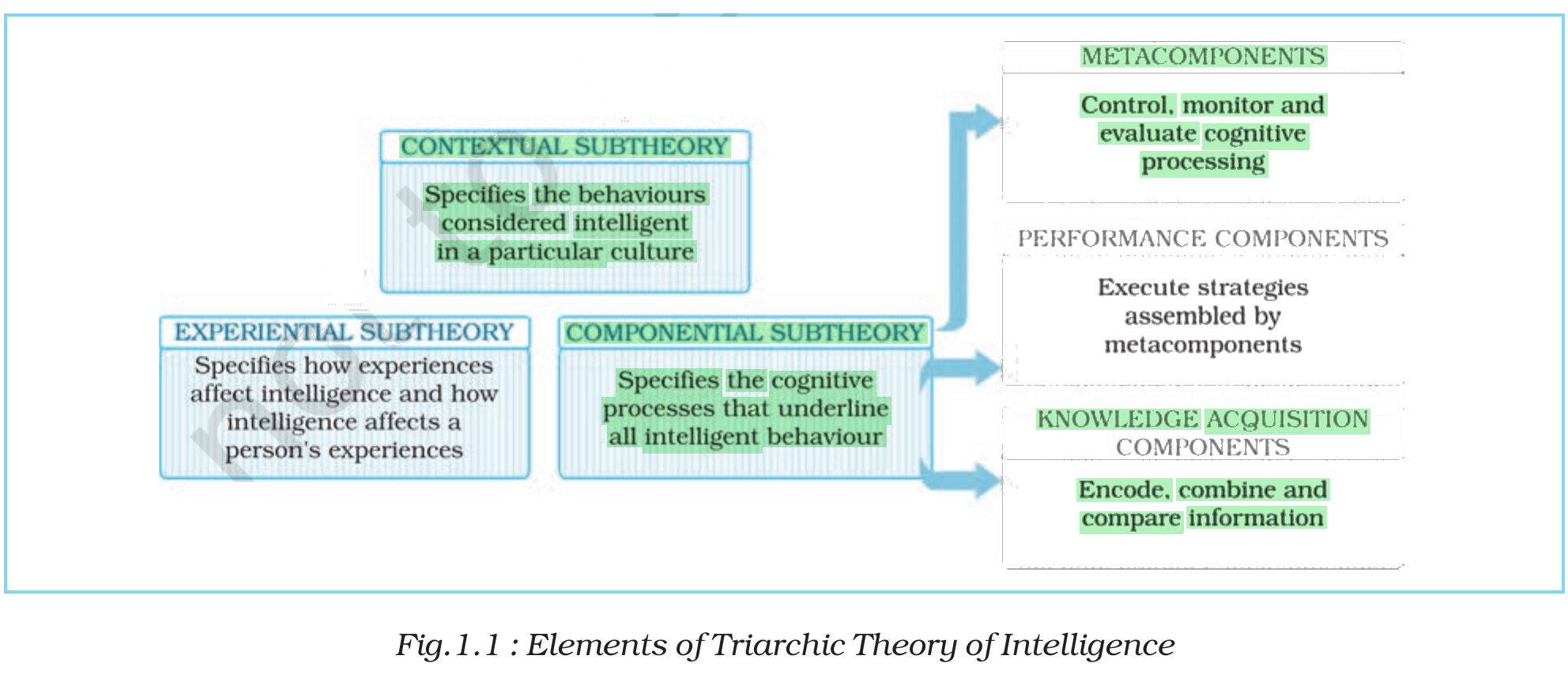
(A)Specifies the behaviors considered intelligent in a particular culture(I)Metacomponents
(B)Specifies the cognitive processes that underline all intelligent behaviour(II)Contextual subtheory
(C)Encode, combine and compare information(III)Componential subtheory
(D)Control, monitor and evaluate cognitive processing(IV)Knowledge acquisition components

Choose the correct answer from the options given below:

Answer & explanation+

Correct answer: option 2

The correct answer is Option (2) → (A)-(II), (B)-(III), (C)-(IV), (D)-(I)

Sternberg’s triarchic theory has three subtheories (contextual, experiential and componential), and the componential part works through three kinds of components: metacomponents, performance components and knowledge acquisition components.

(A) Specifies the behaviors considered intelligent in a particular culture — this matches (II) Contextual subtheory. Contextual (practical) intelligence deals with the environment and culture a person lives in, so this subtheory says which behaviours count as intelligent in a given culture.

(B) Specifies the cognitive processes that underline all intelligent behaviour — this matches (III) Componential subtheory. Componential (analytical) intelligence is the analysis of information to solve problems, so this subtheory spells out the mental processes behind every intelligent act.

(C) Encode, combine and compare information — this matches (IV) Knowledge acquisition components. These are responsible for learning and acquiring the ways of doing things: taking in new information, putting it together and relating it to what is already known.

(D) Control, monitor and evaluate cognitive processing — this matches (I) Metacomponents. The meta or higher-order component involves planning what to do and how to do it, and so directs, watches over and judges the rest of one’s thinking.


NCERT (2025-26): “Triarchic Theory of Intelligence … According to this theory, there are three basic types of intelligence: Componential, Experiential, and Contextual. ……”

“…Componential Intelligence : Componential or analytical intelligence is the analysis of information to solve problems. Persons high on this ability think analytically and critically and succeed in schools. This intelligence has three components, each serving a different function. First is the knowledge acquisition component, which is responsible for learning and acquisition of the ways of doing things. The second is the meta or a higher order component, which involves planning concerning what to do and how to do. The third is the performance component, which involves actually doing things.”

NCERT extract

Advertisement

Practise more on Variations in Psychological Attributes

Chapter-wise mocks on the real NTA exam screen, with solutions and your rank. Your first mocks are free.

Start free mocks →

Advertisement

Next questions

  1. Match the Column I with Column II . Column I Column II A. Tapetum I. Irregularly shaped nucleus with abundant food reserve B. Exine II. Act…Biology · Sexual Reproduction in Flowering Plants
  2. Which of the following techniques can be used to separate the impurities in Milk?General Aptitude Test · General Knowledge
  3. A, B and C entered into a partnership. A invested Rs. 2,560 and B invested Rs. 2,000. At the end of the year, they gained Rs. 1,105 out of…General Aptitude Test · Numerical Ability
  4. The average age of mother, father and son was 42 years at the time of the marriage of the son. After 1 year an infant was born and after 6…General Aptitude Test · General Ability
  5. Select the appropriate meaning of the given idiom. To take French leaveEnglish · Grammar: Idioms
  6. Match List I with List II LIST ILIST II A. If the corner points of the feasible region for an LPP are (0, 4), (5, 0), (7, 9), then the mini…Applied Maths. Section B2 · Linear Programming
  7. Match List I with List II List IList II A. x I. Population mean B. μ II. Degree of freedom C. S III. Sample mean D. v IV. Sample standard d…Applied Maths. Section B2 · Inferential Statistics
  8. A and B are two metals with threshold frequencies 1.8×10^14 Hz and 2.2×10^14 Hz respectively. Two identical photons of energy 0.825 eV each…Physics · Dual Nature of Radiation and Matter
  9. The cut in the interest rates on loans mentioned in the passage is an example of ________.Business Studies · Business Environment
  10. If the supply curve of a good cuts the price axis in its positive range and as we extend the straight line, it cuts the quantity-axis at it…Economics · Micro Economics: Theory of Firms under Perfect Competition