
A alone can do a piece of work in 20 days. B alone can do \(\frac{3}{4}\) of the same work in 9 days and C alone can do \(\frac{1}{2}\) of the same work in 15 days. They started the work and after some days A left the job and if they got Rs. 30000 for the whole work and C get Rs. 5000 more than A. Find after how many days A left the work?
Answer & explanation
Correct answer: option 3
A can do a piece of work in = 20 days
B can do a piece of work in = 9 × \(\frac{4}{3}\) = 12 days
C can do a piece of work in = 15 × \(\frac{2}{1}\) = 30 days
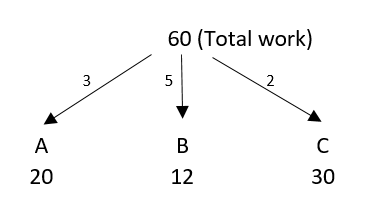
Let A worked for x days and (B+C) for y days and they got Rs. 30000 in total
Hence
60 unit= 30000
1 unit = 500
↓ x5 ↓ x5
5 unit 2500
( C got Rs.5000 more than A so he worked 5 unit more than A)
3 x + 11 y = 60 ------ (i)
2 y - 3 x = 5 ------- (ii)
---------------------------------
13 y = 65
y = 5 ⇒ x = \(\frac{5}{3}\) days