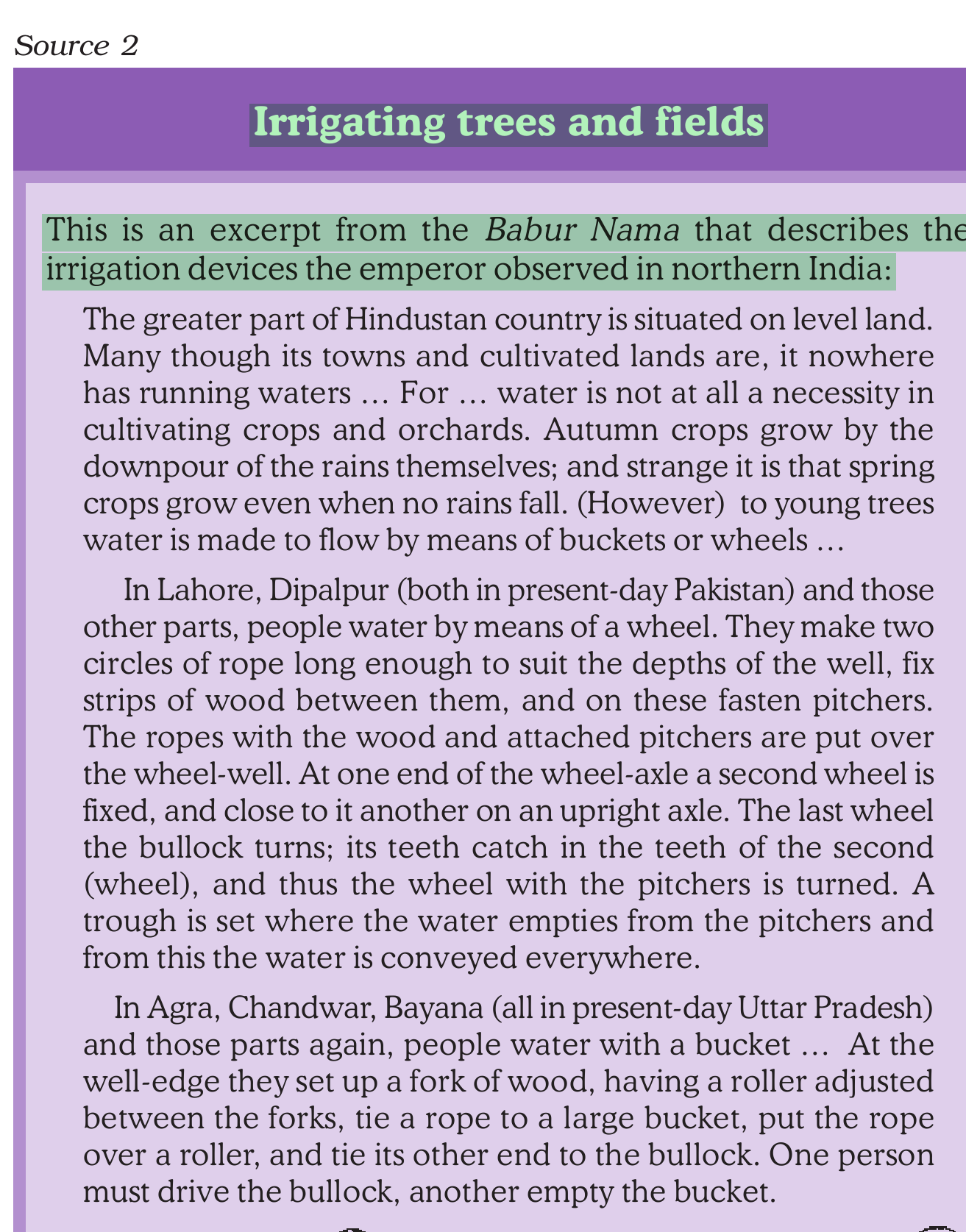
Read the passage and answer the questions:
Agrarian Society and Irrigation of the Mughal Empire
The greater part of Hindustan country is situated on level land. Many though it has towns and cultivated lands, it nowhere has running waters. For water is not at all a necessity in cultivating crops and orchards. Autumn crops grow by the downpour of the rains themselves; and strange it is that spring crops grow even when no rains fall. However to young trees water is made to flow by means of buckets or wheels....In Lahore, Dipalpur both in present-day Pakistan, and those other parts, people water by means of a wheel. They make two circles of rope long enough to suit the depths of a well, fix strips of wood between them, and on these fasten pitchers. The ropes with the wood and attached pitchers are put over the wheel well. In Agra, Chandwar, Bayana all in present-day Uttar Pradesh, and those parts again, people water with a bucket. At the well-edge they set-up a fork of wood, having a roller adjusted between the forks, tie a rope to large bucket, put the rope over a roller, and tie its other end to the bullock. One person must drive the bullock, another empty the bucket.
In the above passage, what is the main topic of discussion?
Answer & explanation
Correct answer: option 1
The correct answer is Option (1) → Irrigation devices
The main subject of the passage is how water is lifted for young trees and fields: in Lahore and Dipalpur people use a wheel with ropes and pitchers, and in Agra, Chandwar and Bayana a bucket pulled up by a bullock. So the passage is about irrigation devices. The level land, the lack of running waters and the crops that grow on rain alone are only the background that explains why such devices were needed.
NCERT (2025-26): “1.3 Irrigation and technology … Monsoons remained the backbone of Indian agriculture, as they are even today. But there were crops which required additional water. Artificial systems of irrigation had to be devised for this.”
|