
CUETMOCK
  • Pricing
  • Mentors
Log inStart freeStart free mocks→

First test, then trust

Try a free CUET mock test.

Join 5,00,000+ students who rehearsed exam day on the exact NTA screen before sitting CUET. On the web and on Android.

Start free mocks →Get the Android app
CUETMOCK

India's #1 CUET Mock Test Platform. Original NCERT-based questions on the exact NTA exam screen — trusted by 5,00,000+ students since CUET 2022.

Get it onGoogle PlayScan to download the CUETMOCK app

Mock tests

  • CUET mock test series
  • Browse all papers
  • Commerce mocks
  • Humanities (Arts) mocks
  • Science mocks
  • Languages & GAT mocks
  • Free practice questions
  • Pricing

Resources

  • CUET exam guide
  • CUET syllabus
  • Universities accepting CUET
  • Expert blogs
  • News & notifications
  • Webinars & counselling
  • CUET score calculator
  • How we estimate your rank
  • FAQs

Company

  • About us
  • Our leadership & team
  • Our toppers
  • Mentors
  • For schools
  • Contact us
  • Terms
  • Privacy
  • Refund policy

Talk to us

+91 7696 6630 56info@cuetmock.comWhatsApp us

Our other platforms

  • JEE Mock — For IIT-JEE aspirants
  • NEET Mock — For NEET aspirants

Newsletter

Exam updates, study material and offers — no spam.

© 2026 NYC Ventures Pvt. Ltd.

701-702, Royal Business Park, Zirakpur, Punjab - 140603

  • Terms of use
  • Privacy policy
  • Refund policy
  • Contact us

iCUETMOCK is an independent preparation platform, not affiliated with the National Testing Agency (NTA). Always check exam details on the official NTA website.

  • Home
  • Mock tests
  • CUET guide
  • Pricing
  • Log in
Home/Practice questions/Chemistry
ChemistryPhysical: Surface Chemistry

Match List I with List II. List I (Example of colloidal system) List…

Match List I with List II.

List I (Example of colloidal system) List II (Types of colloid)
A. Smoke  I. Foam
B. Cheese II. Aerosol
C. Soap lather III. Emulsion
D. Milk IV. Gel

Choose the correct answer from the options given below:

Answer & explanation+

Correct answer: option 1

The correct answer is Option (1) → A-II, B-IV, C-I, D-III

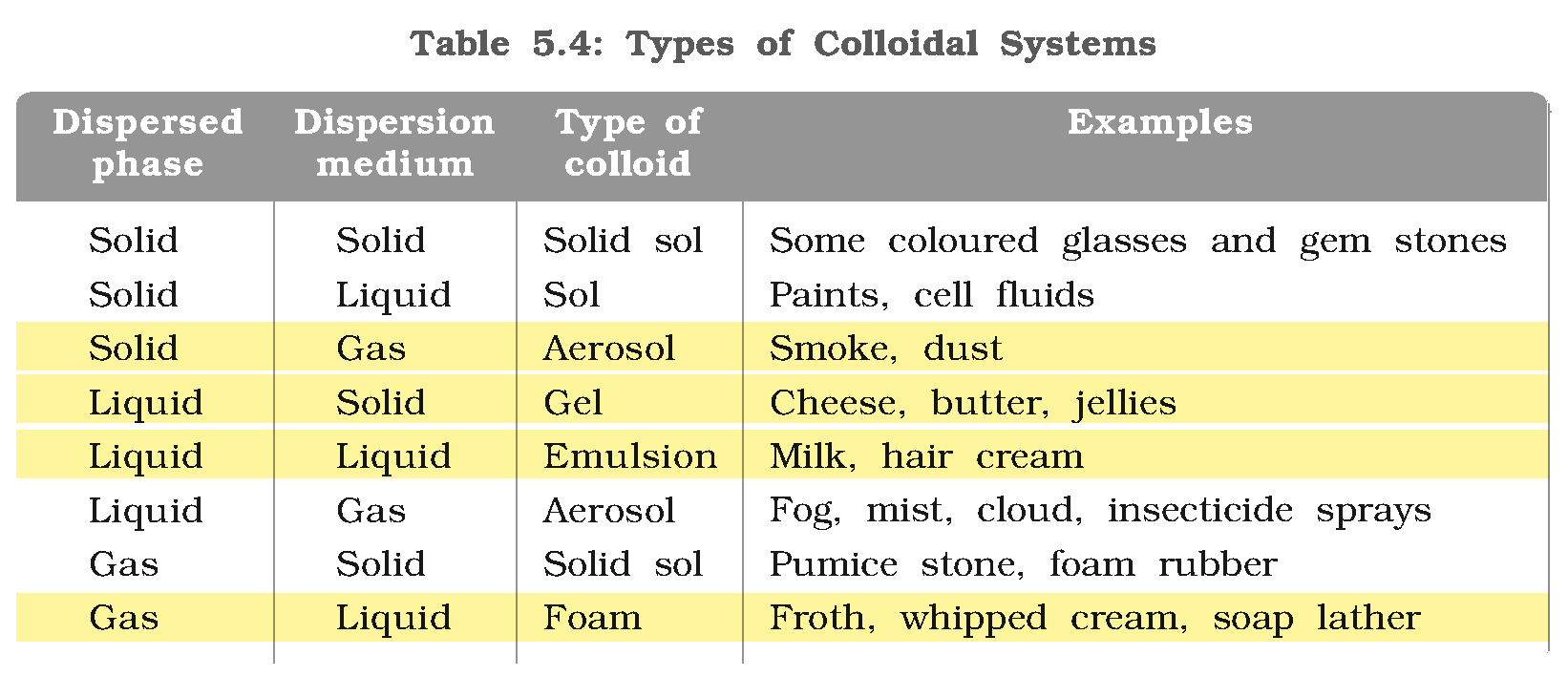
The type of colloid is named from the physical states of the dispersed phase and the dispersion medium:

  • A. Smoke — This matches II. Aerosol. Solid particles dispersed in a gas.

  • B. Cheese — This matches IV. Gel. A liquid dispersed in a solid.

  • C. Soap lather — This matches I. Foam. A gas dispersed in a liquid.

  • D. Milk — This matches III. Emulsion. Liquid fat dispersed in water, a liquid in a liquid.

Note: This question is from the pre-rationalised NCERT book (2022-23). The topic is not there in the latest NCERT book (2026-27), and it is also out of the CUET 2026 syllabus.

NCERT (Pre-rationalised edition, 2022-23):
Classification Based on Physical State of Dispersed Phase and Dispersion Medium – …
Textbook extract

Advertisement

Practise more on Physical: Surface Chemistry

Chapter-wise mocks on the real NTA exam screen, with solutions and your rank. Your first mocks are free.

Start free mocks →

Advertisement

Next questions

  1. The area of a quadrant of a circle is (π)/9 m^2. Its radius (in metres) is equal to:General Aptitude Test · Quantitative Reasoning
  2. Which among the following statement is incorrect about methanogens ?Biology · Microbes in Human Welfare
  3. Select the answer figure in which the question figure is hidden?General Aptitude Test · Verbal Reasoning
  4. A sum of money becomes five times at 8% simple rate of interest per annum. At what rate percent will it become seven fold?General Aptitude Test · Numerical Ability
  5. Which of the following is not a part of final expenditure while calculating National Income using Expenditure Method?Economics · Macro Economics: National Income Accounting
  6. The gravitational potential on the surface of a planet of radius R massPhysics · Gravitation
  7. The difference of cubes of two numbers is 999. The numbers are in the ratio of 4 : 3. What is the square of the smaller number?General Aptitude Test · Numerical Ability
  8. The order of the differential equation, whose general solution is y=C_1 e^x+C_2 e^2 x+C_3 e^3 x+C_4 e^x+c_5, where C_1, C_2, C_3, C_4, C_5…Maths. Section A · Differential Equations
  9. Select the most appropriate meaning of the given idiom. To lose one's headEnglish · Grammar: Idioms
  10. Study the following table and answer the questions. Number of machines (in thousands) sold by dealers A, B, C, D and E during six months of…General Aptitude Test · Quantitative Reasoning