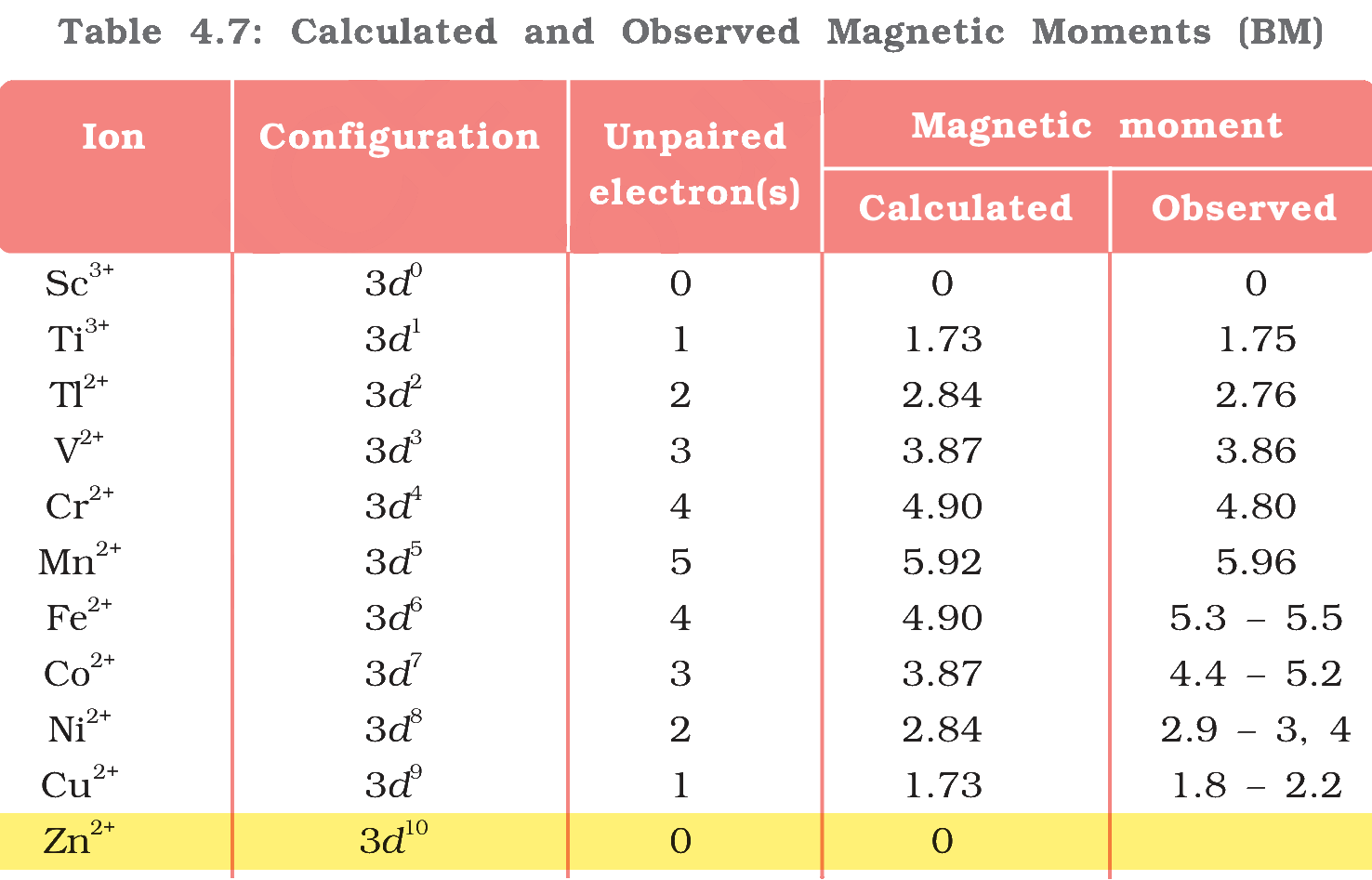
Paramagnetic substances are attracted by an external magnetic field, that is, they move from a weaker to a stronger part of the field. Paramagnetic substances contain unpaired electrons. Diamagnetic substances are repelled by an external magnetic field, that is, they tend to move away from the stronger part to the weaker part of the field. In diamagnetic substances, all the electrons are paired.
The magnetic moment of a substance arises from the spin angular momentum and the orbital angular momentum of its electrons. In many compounds of the 3d series metals, the orbital contribution is neglected, because the orbital motion of these electrons is quenched by the surrounding species in the compound or solution. The magnetic moment is then calculated by the spin-only formula, in Bohr magnetons (BM):
\[\mu_s = \sqrt{n(n + 2)}\ \text{BM}\]
where n is the number of unpaired electrons.
Which of the following ions has no unpaired electrons and is therefore diamagnetic?
Answer & explanation
Correct answer: option 4
The correct answer is Option (4) → Zn2+
A diamagnetic substance has all its electrons paired; an ion with even one unpaired electron is paramagnetic. So the ion needed has a d subshell that is either empty or completely filled.
Configuration of Zn: Z = 30, [Ar]3d104s2.
\( \ce{Zn^2+} \): losing the two 4s electrons gives 3d10.
Unpaired electrons: all five 3d orbitals hold pairs, so n = 0.
Magnetic moment: \( \mu=\sqrt{0(0+2)}=0 \), so the ion is diamagnetic.
Why the other options are incorrect
Option (1) Co2+ — Incorrect. Co (Z = 27) loses its two 4s electrons to give 3d7, with 3 unpaired electrons, so it is paramagnetic.
Option (2) Ni2+ — Incorrect. Ni (Z = 28) gives 3d8, with 2 unpaired electrons, so it is paramagnetic.
Option (3) Cu2+ — Incorrect. Cu (Z = 29, [Ar]3d104s1) loses the 4s electron and one 3d electron to give 3d9, with 1 unpaired electron, so it is paramagnetic.
NCERT (2026-27 edition):
4.3.9 Magnetic Properties