
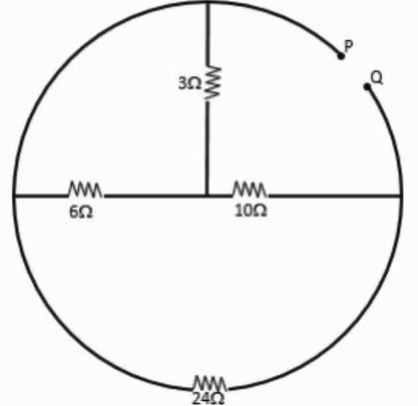
The equivalent resistance between P and Q is:
Answer & explanation
Correct answer: option 1
The correct answer is Option (1) → 8 Ω
Given: We need to find the equivalent resistance between points $P$ and $Q$.
From the circuit, observe that the $3\ \Omega$ resistor (vertical) and the $6\ \Omega$ resistor (left side) are connected between the same two points — both joining the top point $P$ to the central node.
Hence, they are in parallel:
$R_{PO} = \left( \frac{1}{3} + \frac{1}{6} \right)^{-1} = 2\ \Omega$
Now, the circuit reduces to a triangle between points $P$, $O$, and $Q$ with the following resistances:
- $P$–$O$ branch: $2\ \Omega$
- $O$–$Q$ branch: $10\ \Omega$
- $P$–$Q$ branch (outer arc): $24\ \Omega$
The path through $O$ gives a total resistance of:
$R_{POQ} = R_{PO} + R_{OQ} = 2 + 10 = 12\ \Omega$
This $12\ \Omega$ path is in parallel with the direct $24\ \Omega$ branch between $P$ and $Q$:
$R_{PQ} = \left( \frac{1}{24} + \frac{1}{12} \right)^{-1}$
Calculate:
$R_{PQ} = \frac{24 \times 12}{24 + 12} = \frac{288}{36} = 8\ \Omega$
Hence, the equivalent resistance between P and Q is: $R_{PQ} = 8\ \Omega$