The reagents used in the conversion are:
Answer & explanation
Correct answer: option 2
The correct answer is Option (2) → LiAlH4 H2O
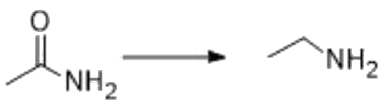
The given conversion changes ethanamide into ethanamine, with the same number of carbon atoms:
\( \displaystyle \ce{CH3CONH2 -> CH3CH2NH2} \)
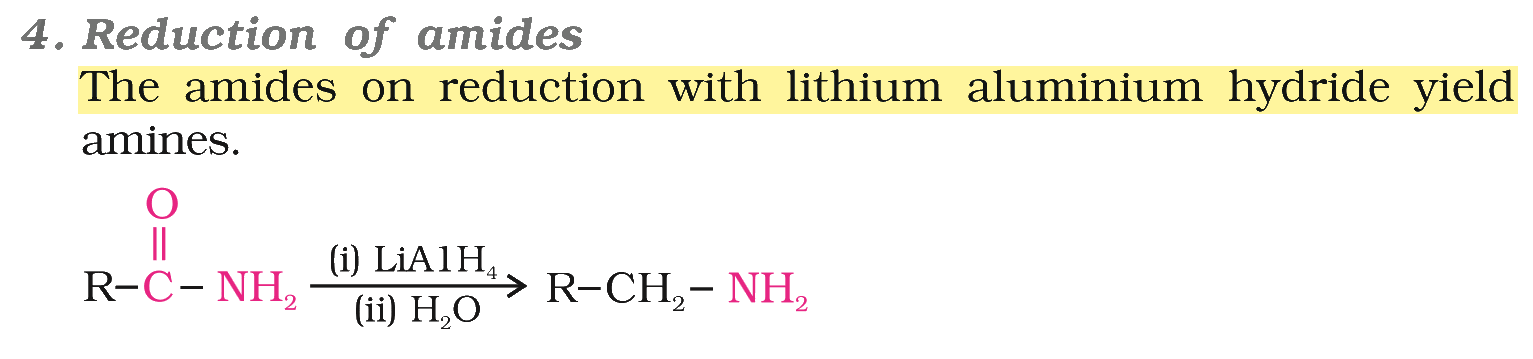
The C=O group of the amide becomes a \( \ce{CH2} \) group. This is a reduction. Amides are reduced to amines by lithium aluminium hydride, followed by water to decompose the complex formed:
\( \displaystyle \ce{CH3CONH2} \xrightarrow[\text{(ii) }\ce{H2O}]{\text{(i) }\ce{LiAlH4}} \ce{CH3CH2NH2} \)
So the reagents are LiAlH4 followed by H2O.
Why the other options are incorrect
Option (1) Zn-Hg/HCl — Incorrect. This is the Clemmensen reduction, which converts the C=O group of aldehydes and ketones to \( \ce{CH2} \). It is not used to reduce amides to amines.
\( \displaystyle \ce{CH3COCH3 + 4[H]} \xrightarrow{\ce{Zn-Hg}\text{/conc. }\ce{HCl}} \ce{CH3CH2CH3 + H2O} \)
Option (3) Pd-BaSO4 — Incorrect. \( \ce{H2} \) over Pd-\( \ce{BaSO4} \) is the Rosenmund reduction, which converts an acyl chloride to an aldehyde.
\( \displaystyle \ce{CH3COCl + H2} \xrightarrow{\ce{Pd-BaSO4}} \ce{CH3CHO + HCl} \)
Option (4) H+/KMnO4 — Incorrect. Acidified \( \ce{KMnO4} \) is an oxidising agent, while this conversion is a reduction.
NCERT (2026-27 edition):
Reduction of Amides