CUETMOCK
  • Pricing
  • Mentors
Log inStart freeStart free mocks→

First test, then trust

Try a free CUET mock test.

Join 5,00,000+ students who rehearsed exam day on the exact NTA screen before sitting CUET. On the web and on Android.

Start free mocks →Get the Android app
CUETMOCK

India's #1 CUET Mock Test Platform. Original NCERT-based questions on the exact NTA exam screen — trusted by 5,00,000+ students since CUET 2022.

Get it onGoogle PlayScan to download the CUETMOCK app

Mock tests

  • CUET mock test series
  • Commerce mocks
  • Humanities (Arts) mocks
  • Science mocks
  • Languages & GAT mocks
  • Free practice questions
  • Pricing

Resources

  • CUET exam guide
  • CUET syllabus
  • Universities accepting CUET
  • Expert blogs
  • News & notifications
  • Webinars & counselling
  • CUET score calculator
  • How we estimate your rank
  • FAQs

Company

  • About us
  • Our leadership & team
  • Our toppers
  • Mentors
  • For schools
  • Contact us
  • Terms
  • Privacy
  • Refund policy

Talk to us

+91 7696 6630 56info@cuetmock.comWhatsApp us

Our other platforms

  • JEE Mock — For IIT-JEE aspirants
  • NEET Mock — For NEET aspirants

Newsletter

Exam updates, study material and offers — no spam.

© 2026 NYC Ventures Pvt. Ltd.

701-702, Royal Business Park, Zirakpur, Punjab - 140603

  • Terms of use
  • Privacy policy
  • Refund policy
  • Contact us

iCUETMOCK is an independent preparation platform, not affiliated with the National Testing Agency (NTA). Always check exam details on the official NTA website.

  • Home
  • Mock tests
  • CUET guide
  • Pricing
  • Log in
Home/Practice questions/Biology
BiologyHuman Health and Disease

The production of the toxic substance haemozoin is associated with:

The production of the toxic substance haemozoin is associated with:

Answer & explanation+

Correct answer: option 2

The correct answer is Option (2) → RBCs

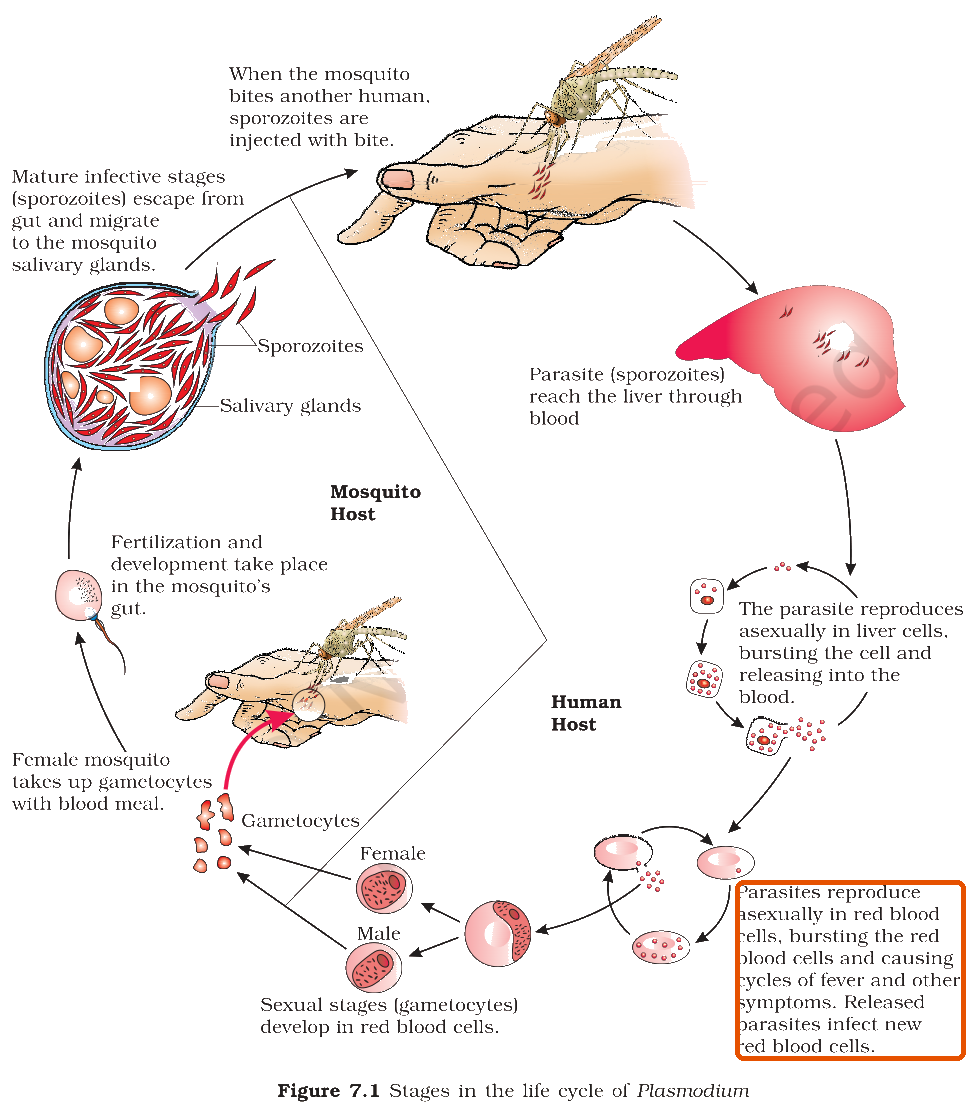
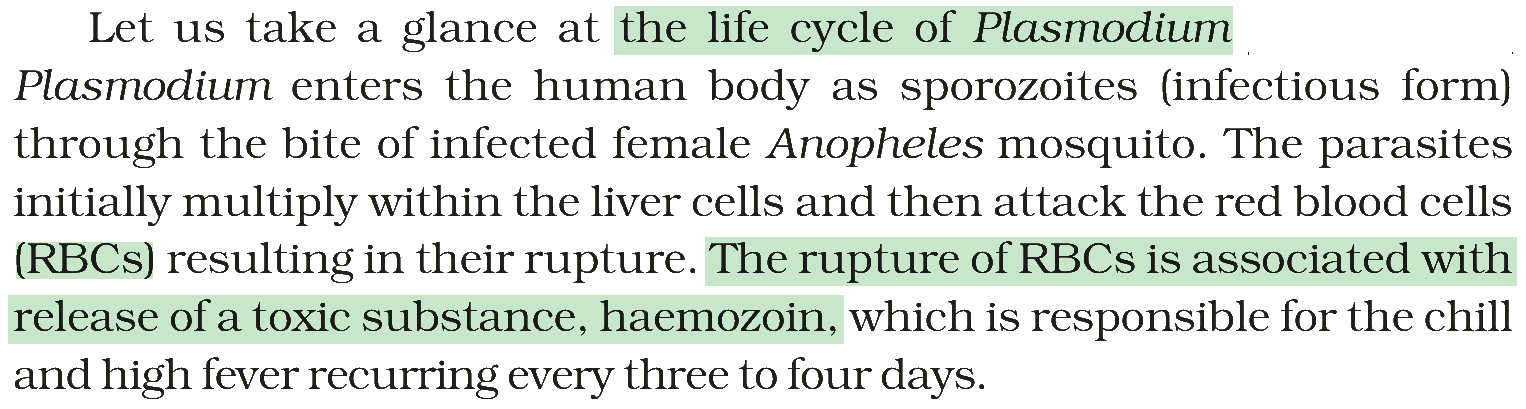
Haemozoin is a toxic substance made in malaria. The malarial parasite Plasmodium multiplies inside the red blood cells and bursts them. Each burst releases haemozoin, which causes the chill and high fever that return every three to four days.

(1) Lymphocytes — Incorrect. These are white blood cells (B and T cells) that give immunity. They do not make haemozoin.

(2) RBCs — Correct. The release of haemozoin is linked to the rupture of RBCs.

(3) Liver cells — Incorrect. The parasite first multiplies in the liver cells, but haemozoin is released only when the RBCs rupture.

(4) Leukocytes — Incorrect. These are the white blood cells that fight infection. They are not the cells that burst in malaria.

NCERT Extract:
Common Diseases in Humans – …
Textbook extract

Textbook figure

Advertisement

Practise more on Human Health and Disease

Chapter-wise mocks on the real NTA exam screen, with solutions and your rank. Your first mocks are free.

Start free mocks →

Advertisement

Next questions

  1. The area of the region bounded by curves y=x^2 and line y=4 is:Applied Maths. Section B2 · Calculus
  2. Which of the option figures completes the given pattern?General Aptitude Test · Non-Verbal Reasoning
  3. Before paper was introduced in the fourteenth century, on what material were early Jain paintings traditionally done?Fine Arts · The Manuscript Painting Tradition
  4. Identify the objective behind introduction of structural reforms in China.Economics · Indian Economic Development: Comparative Development Experiences of India and its Neighbours
  5. The question below is followed by three statements numbered I, II and III. Decide which of the statements are sufficient to answer the ques…General Aptitude Test · Verbal Reasoning
  6. Choose the word that best expresses the meaning of the phrasal verb “talk down to”.English · Grammar: Phrasal Verb
  7. Ritu invested Rs. 1,60,000 in a fund. At the end of one year, the value of her investment was Rs. 1,84,000. During the year she paid Rs. 3,…Applied Maths. Section B2 · Financial Mathematics
  8. The tone of the narrator in the passage can best be described asEnglish · Comprehension - (Poetry / Literary)
  9. Energy obtained from the heat of hot regions deep inside the Earth is calledGeneral Aptitude Test · General Knowledge
  10. The 3-year moving averages for the following data are Year201920202021202220232024 Production (in thousand tonnes)142017262935Applied Maths. Section B2 · Index Numbers and Time Based Data