The potassium dichromate (K2Cr2O7) is
(A) strong oxidizing agent.
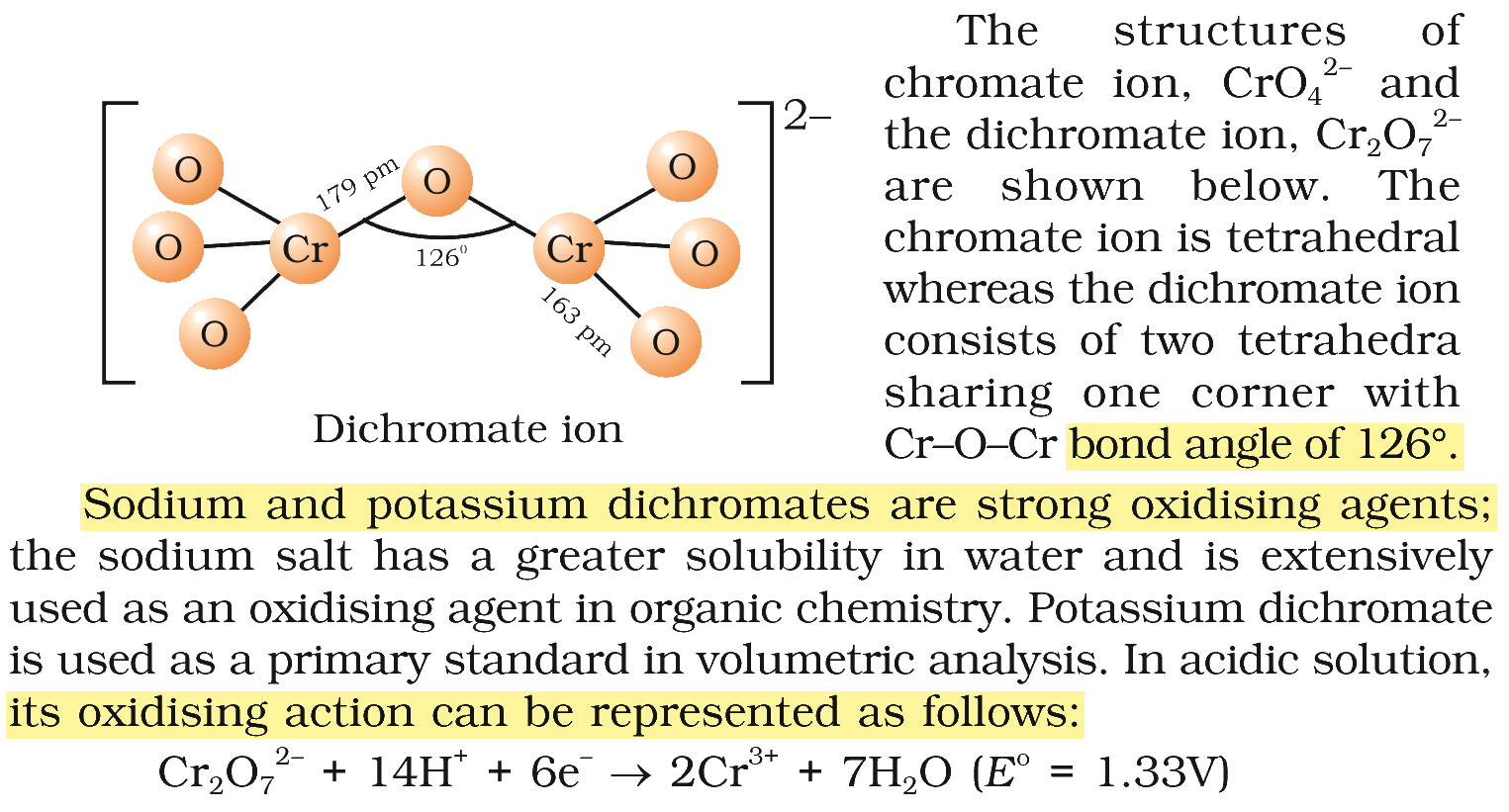
(B) the bond angle between Cr-O-Cr is 126°
(C) reduced to Cr3+ in acidic solution
(D) pentagonal bipyramidal in shape
Choose the correct answer from the options given below:
Answer & explanation
Correct answer: option 2
The correct answer is Option (2) → (A), (B) and (C) only
In potassium dichromate, chromium is in the +6 oxidation state. In acid solution Cr(+6) is readily reduced to the stable Cr(+3) state, which makes it a strong oxidising agent:
\( \displaystyle \ce{Cr2O7^2- + 14H^+ + 6e^- -> 2Cr^3+ + 7H2O} \)
(A) strong oxidizing agent. — Correct. The high positive E° shows that dichromate readily accepts electrons. In acid solution it oxidises iodide to iodine, \( \ce{Fe^{2+}} \) to \( \ce{Fe^{3+}} \) and \( \ce{H2S} \) to sulphur.
(B) the bond angle between Cr-O-Cr is 126° — Correct. The two \( \ce{CrO4} \) tetrahedra are joined through the shared oxygen atom, and the Cr–O–Cr angle at this bridge is 126°.
(C) reduced to Cr3+ in acidic solution — Correct. As the half-equation shows, each Cr(+6) gains three electrons; the orange solution turns green because of \( \ce{Cr^{3+}} \).
(D) pentagonal bipyramidal in shape — Incorrect. Each chromium atom is surrounded tetrahedrally by four oxygen atoms. A pentagonal bipyramid needs seven groups around one atom, as in \( \ce{IF7} \).
NCERT (2026-27 edition):
Oxides and Oxoanions of Metals – …