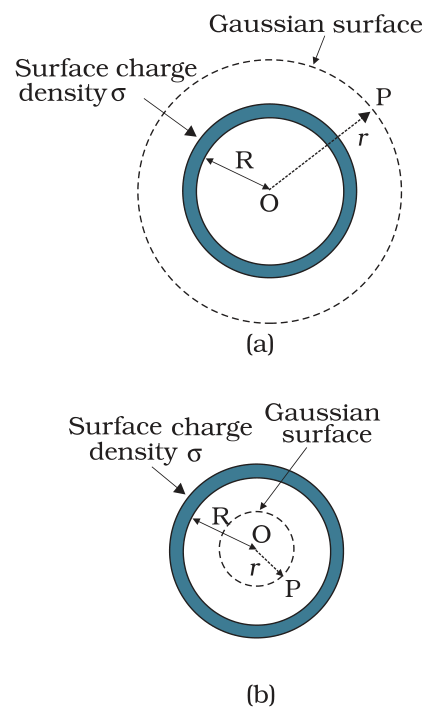
Let q be the charge uniformly distributed over a thin spherical shell of radius R. The electric field at a point which is at a distance r (r < R) from the centre will be :
Answer & explanation
Correct answer: option 1
The correct answer is Option (1) → Zero
Apply Gauss’s law to a spherical surface of radius r (r < R) concentric with the shell. All the charge lies on the shell, so this surface encloses no charge.
\( \displaystyle \oint \vec{E}\cdot d\vec{S} = \frac{q_{\mathrm{enc}}}{\varepsilon_0} \)
\( E\,(4\pi r^{2}) = 0 \)
\( E = 0 \)
Why the other options are incorrect
Option (2) \( \displaystyle\frac{q}{4\pi\epsilon_0 R^{2}}\,\hat{r} \) — Incorrect. This is the field just outside the surface of the shell (r = R), not inside it.
Option (3) \( \displaystyle\frac{-q}{4\pi\epsilon_0 r^{2}}\,\hat{r} \) — Incorrect. Apart from the wrong sign, this is the field outside the shell (r > R).
Option (4) \( \displaystyle\frac{+q}{4\pi\epsilon_0 r^{2}}\,\hat{r} \) — Incorrect. This is the field outside the shell (r > R), where the shell behaves as if all its charge were at the centre.
NCERT (2026-27):
Field Due to a Uniformly Charged Thin Spherical Shell – “… (ii) Field inside the shell: In Fig. 1.28(b), the point P is inside the shell. The Gaussian surface is again a sphere through P centred at O. The flux through the Gaussian surface, calculated as before, is \( E \times 4\pi r^{2} \). However, in this case, the Gaussian surface encloses no charge. Gauss’s law then gives
\( \displaystyle \begin{array}{l} E \times 4\pi r^{2} = 0 \\ \text{i.e.,}\quad E = 0 \qquad (r \lt R) \qquad (1.35) \end{array} \)
that is, the field due to a uniformly charged thin shell is zero at all points inside the shell*.”