Optically active alkyl halide undergoing \( S_N2 \) substitution involves
Answer & explanation
Correct answer: option 3
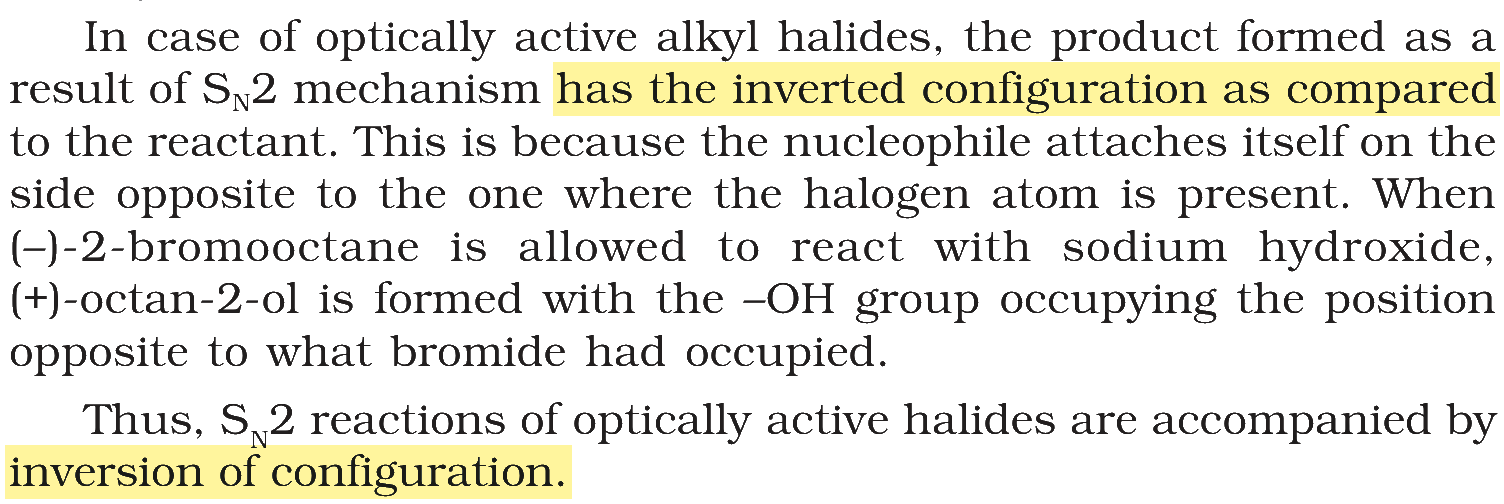
The correct answer is Option (3) → inversion of configuration
An \(S_N2\) reaction takes place in one step. The nucleophile attacks the carbon atom from the side opposite to the halogen, and as the new bond forms the old C–X bond breaks. The other three groups on the carbon flip over, like an umbrella turned inside out in the wind, so the product has the inverted configuration.
\( \displaystyle (-)\text{-}\ce{CH3(CH2)5CHBrCH3} + \ce{OH-} \xrightarrow{S_N2} (+)\text{-}\ce{CH3(CH2)5CH(OH)CH3} + \ce{Br-} \)
Why the other options are incorrect
Option (1) retention of configuration — Incorrect. Backside attack cannot leave the groups in their original arrangement.
Option (2) racemic mixture — Incorrect. Racemisation happens in \(S_N1\) reactions, where the flat carbocation is attacked from both faces equally.
Option (4) formation of carbocation — Incorrect. A carbocation is the intermediate of the two-step \(S_N1\) mechanism; \(S_N2\) has a single transition state and no intermediate.
NCERT (2026-27 edition):
Inversion, Retention and Racemisation – …