Arrange the following in chronological order.
A. The Naxalite Movement
B. Garibi Hatao
C. Railway strike
D. Keshavananda Bharati case
E. Declaration of Emergency
Choose the correct answer from the options given below:
Answer & explanation
Correct answer: option 2
The correct answer is Option (2) → A, B, D, C, E
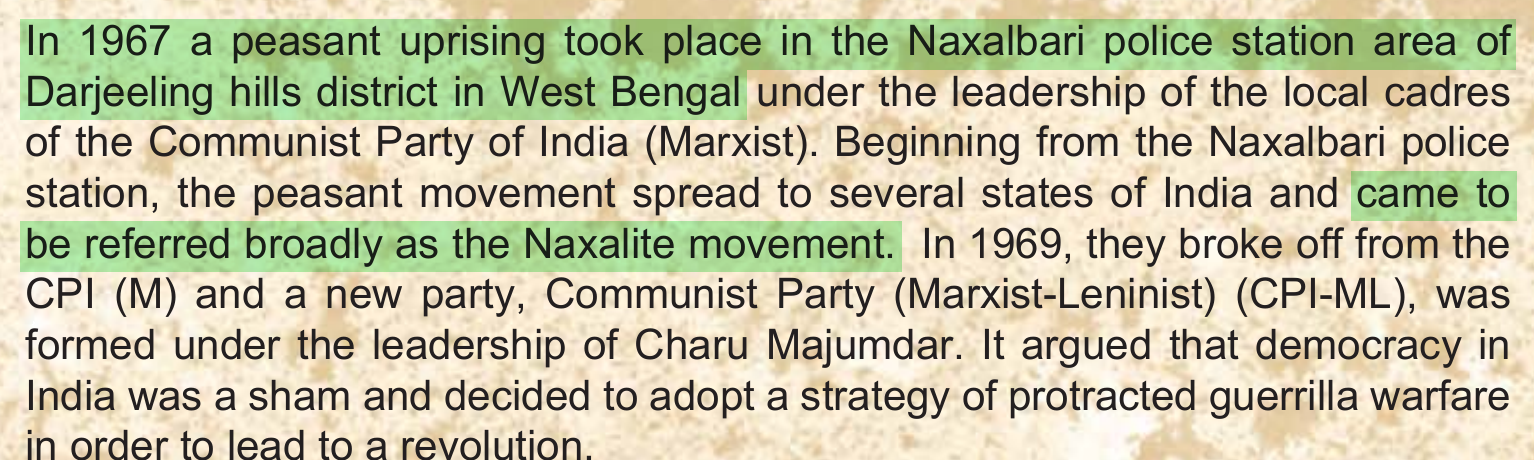
(A) The Naxalite Movement — 1967, the peasant uprising at Naxalbari in West Bengal.
(B) Garibi Hatao — 1971, Indira Gandhi’s slogan in the Lok Sabha elections.
(D) Keshavananda Bharati case — 1973, the Supreme Court’s decision on the basic features of the Constitution.
(C) Railway strike — 1974.
(E) Declaration of Emergency — 25 June 1975.
Note: The section ‘Naxalite Movement’ of the chapter ‘The Crisis of Democratic Order’, which dates the movement to 1967, was there in the pre-rationalised NCERT; this portion has been deleted from subsequent editions of NCERT, including the NCERT book (2026-27), though the chapter is still there.
NCERT (2026-27): “The 1971 Election and Restoration of Congress … In order to end her dependence on other political parties, strengthen her party’s position in the Parliament, and seek a popular mandate for her programmes, Indira Gandhi’s government recommended the dissolution of the Lok Sabha in December 1970. This was another surprising and bold move. The fifth general election to Lok Sabha were held in February 1971. The contest … Yet the new Congress had something that its big opponents lacked – it had an issue, an agenda and a positive slogan. The Grand Alliance did not have a coherent political programme. Indira Gandhi said that the opposition alliance had only one common programme: Indira Hatao (Remove Indira). In contrast to this, she put forward a positive programme captured in the famous slogan: Garibi Hatao (Remove Poverty).… Conflict with Judiciary … Two developments further added to the tension between the judiciary and the executive. Immediately after the Supreme Court’s decision in 1973 in the Keshavananda Bharati case, a vacancy arose for the post of the Chief Justice of India. It had been a practice to appoint the senior-most judge of the Supreme Court as the Chief Justice. But in 1973, the government set aside the seniority of three judges and appointed Justice A. N. Ray as the Chief Justice of India.… Railway Strike of 1974 … What would happen when the railways stop running? Not for one or two days, but for more than a week? Of course, many people would be inconvenienced; but more than that, the economy of the country would come to a halt because goods are transported from one part to another by trains. Do you know that such a thing actually happened in 1974?… Crisis and response … The response of the government was to declare a state of emergency. On 25 June 1975, the government declared that there was a threat of internal disturbances and therefore, it invoked Article 352 of the Constitution. Under the provision of this article the government could declare a state of emergency on grounds of external threat or a threat of internal disturbances.…” NCERT (Pre-rationalised), chapter ‘The Crisis of Democratic Order’: the section ‘Naxalite Movement’
|