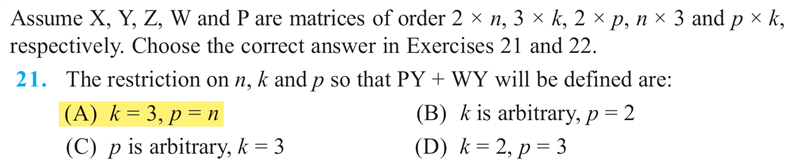
Let A, B, C be matrices of order \(p \times k\), \(3 \times k\) and \(n \times 3\) respectively, then the conditions on n, k and p so that AB + CB will be defined are :
Answer & explanation
Correct answer: option 2
The correct answer is Option (2) → k = 3, p = n
A product XY is defined only when the number of columns of X equals the number of rows of Y, and a sum is defined only for matrices of the same order.
AB: A is \(p \times k\) and B is \(3 \times k\), so A must have 3 columns:
\(k = 3\)
AB is of order \(p \times k = p \times 3\)
CB: C is \(n \times 3\) and B is \(3 \times k\), so CB is defined and
CB is of order \(n \times k = n \times 3\)
For AB + CB, the two orders must be equal:
\(p \times 3 = n \times 3,\quad p = n\)
So k = 3 and p = n.
NCERT (2026-27 edition):
Multiplication of Matrices