
A convex mirror is used to form an image of a real object. Which of the following statements is wrong?
Answer & explanation
Correct answer: option 4
The correct answer is Option (4) → The image is real
For a convex mirror the focus lies behind the mirror. So, with the Cartesian sign convention, \( f\gt0 \). A real object in front of the mirror has \( u\lt0 \). The mirror equation gives:
\( \displaystyle \frac{1}{v}=\frac{1}{f}-\frac{1}{u} \)
Both terms on the right are positive, so \( v\gt0 \) and \( 1/v\gt1/f \), that is, \( 0\lt v\lt f \). The image is behind the mirror, between the pole and the focus. Since \( v\lt|u| \), the magnification \( m=-v/u \) is positive and less than 1.
Option (1) The image lies between the pole and the focus — True statement. From the mirror equation, \( 0\lt v\lt f \) for every position of a real object.
Option (2) The image is diminished in size — True statement. The image is nearer the mirror than the object, so \( |m|\lt1 \).
Option (3) The image is erect — True statement. \( m \) is positive, and a positive magnification means an erect image.
Option (4) The image is real — Wrong statement. The reflected rays only appear to diverge from a point behind the mirror (\( v\gt0 \)). So the image of a real object is always virtual and cannot be taken on a screen.
NCERT (2026-27):
The Mirror Equation – “We have derived here the mirror equation, … and the magnification formula, … for the case of real, inverted image formed by a concave mirror. With the proper use of sign convention, these are, in fact, valid for all the cases of reflection by a spherical mirror (concave or convex) whether the image formed is real or virtual. Figure 9.6 shows the ray diagrams for virtual image formed by a concave and convex mirror.”
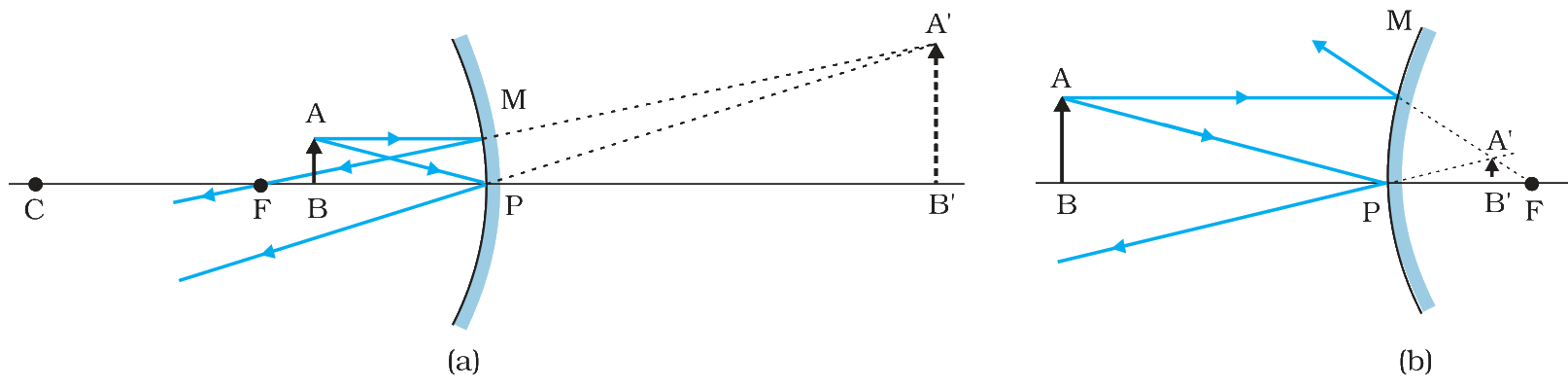
FIGURE 9.6 Image formation by (a) a concave mirror with object between P and F, and (b) a convex mirror.