In Khasi society who does not make decision in regard to the property.
A. Mother's Brother
B. Mother's Husband
C. Daughter
D. Mother
Choose the correct answer from the options given below:
Answer & explanation
Correct answer: option 3
The correct answer is Option (3) → B, C and D only
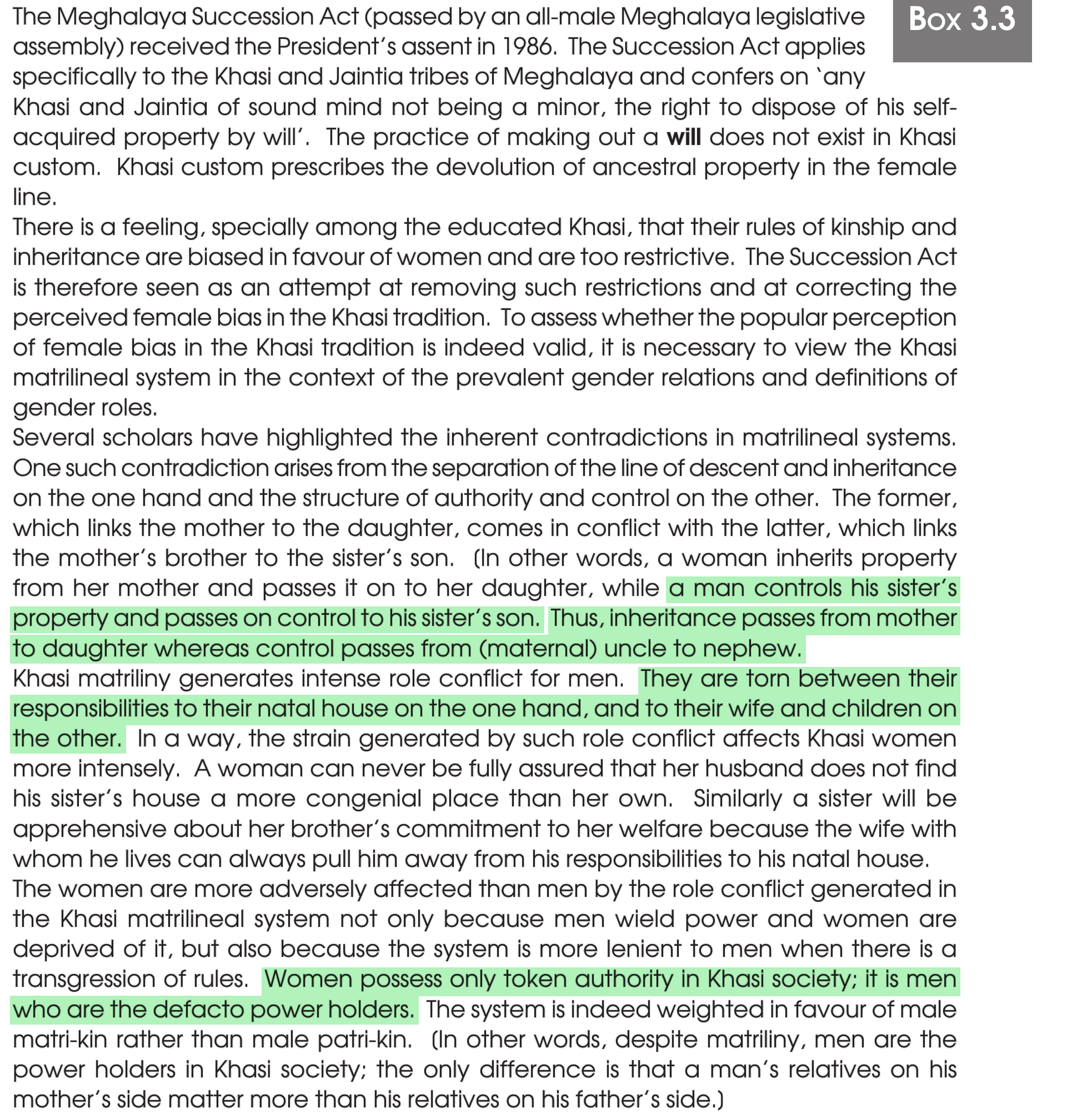
In Khasi society property passes in the female line, but the control of that property lies with men of the mother’s side: inheritance passes from mother to daughter, whereas control passes from the maternal uncle to the nephew.
A. Mother’s Brother Makes the decisions (Incorrect). A man controls his sister’s property and passes on this control to his sister’s son. So the mother’s brother is the one who decides about the property.
B. Mother’s Husband Does not make the decisions (Correct). A husband has no control over his wife’s property. His authority lies in his own natal house, over his sister’s property, which is why he is torn between his wife and children and his sister’s family.
C. Daughter Does not make the decisions (Correct). The daughter inherits the property from her mother, but inheriting it does not give her control over it.
D. Mother Does not make the decisions (Correct). The mother holds the property and passes it on to her daughter, but women possess only token authority in Khasi society; it is men who are the de facto power holders.
Note: Box 3.3 on the Khasi matrilineal family, in the chapter ‘Social Institutions: Continuity and Change’, was there in the pre-rationalised NCERT, which NTA followed in 2023. This box has been deleted from the NCERT book (2025-26), though the chapter and its section on matriliny and matriarchy are still there.
NCERT: Indian Society — Chapter 3: Social Institutions: Continuity and Change, Box 3.3 (Pre-rationalised)
|