
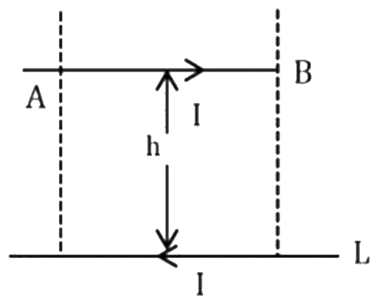
A long straight wire L carrying a current of 20 A rests on a table. Another wire AB of length 1 m and mass 2 g carries the same current but in opposite direction. The wire AB is free to move up and down. The value of height h to which AB rises and remains at rest there, will be.
(Given μo = 4π × 10–7 Tm/A, g = 10 m/s2 )
Answer & explanation
Correct answer: option 1
The correct answer is Option (1) → 0.4 cm
The currents in L and AB are in opposite directions, so the wires repel. AB rises until the upward magnetic force on it balances its weight.
The force on a length l of wire due to a long parallel wire at distance h is
\( \displaystyle F = \frac{\mu_0 I_1 I_2\, l}{2\pi h} \)
In equilibrium F = mg, with \( I_1 = I_2 = I \):
\( \displaystyle \frac{\mu_0 I^{2} l}{2\pi h} = mg \;\Rightarrow\; h = \frac{\mu_0 I^{2} l}{2\pi mg} \)
\( m = 2\,\mathrm{g} = 2\times10^{-3}\,\mathrm{kg} \)
\( \displaystyle h = \frac{4\pi\times10^{-7}\,\mathrm{T\,m\,A^{-1}} \times (20\,\mathrm{A})^{2} \times 1\,\mathrm{m}}{2\pi \times 2\times10^{-3}\,\mathrm{kg} \times 10\,\mathrm{m\,s^{-2}}} \)
\( \displaystyle h = \frac{2\times10^{-7} \times 400}{2\times10^{-2}}\,\mathrm{m} \)
\( h = 4\times10^{-3}\,\mathrm{m} = 0.4\,\mathrm{cm} \)
Note: NTA picked this question from an NCERT Exemplar problem and changed the figures. Do not ignore the Exemplar while practising numericals.
NCERT Exemplar:
Moving Charges and Magnetism – …
