What is the correct order of spin-only magnetic moment (in B.M.) of \(Mn^{2+}, Cr^{2+}\) and \(V^{2+}\)?
Answer & explanation
Correct answer: option 3
The correct answer is Option (3) → \(Mn^{2+} > Cr^{2+} > V^{2+}\)
The spin-only magnetic moment of an ion comes from its unpaired electrons. For ions of the first transition series it is given by:
\( \displaystyle \mu=\sqrt{n(n+2)}\,\mathrm{BM} \)
where n is the number of unpaired electrons. The more unpaired electrons, the larger the magnetic moment.
\( \ce{Mn^2+} \) — first (highest).
Configuration: Mn (Z = 25) is [Ar]3d54s2.
Electrons removed: removing the two 4s electrons gives \( \ce{Mn^2+} \): 3d5.
Unpaired electrons: the five d electrons occupy the five d orbitals singly, so n = 5:
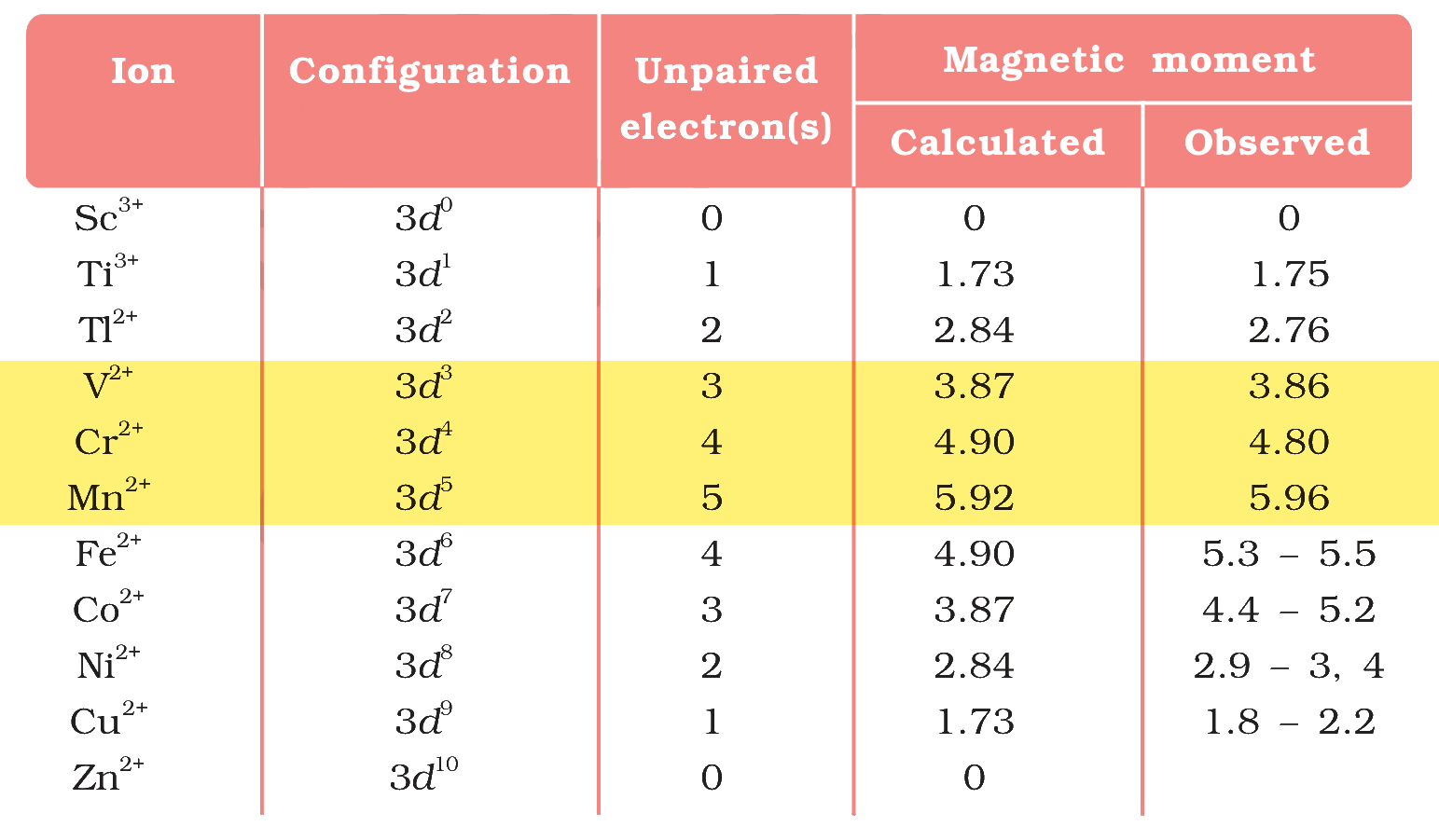
\( \displaystyle \mu=\sqrt{5(5+2)}=\sqrt{35}=5.92\,\mathrm{BM} \)
\( \ce{Cr^2+} \) — second.
Configuration: Cr (Z = 24) is [Ar]3d54s1 (half-filled d subshell).
Electrons removed: removing the 4s electron and one 3d electron gives \( \ce{Cr^2+} \): 3d4.
Unpaired electrons: four unpaired electrons, so n = 4:
\( \displaystyle \mu=\sqrt{4(4+2)}=\sqrt{24}=4.90\,\mathrm{BM} \)
\( \ce{V^2+} \) — third (lowest).
Configuration: V (Z = 23) is [Ar]3d34s2.
Electrons removed: removing the two 4s electrons gives \( \ce{V^2+} \): 3d3.
Unpaired electrons: three unpaired electrons, so n = 3:
\( \displaystyle \mu=\sqrt{3(3+2)}=\sqrt{15}=3.87\,\mathrm{BM} \)
NCERT (2026-27 edition):
Magnetic Properties – “The magnetic moment increases with the increasing number of unpaired electrons. … The magnetic moments calculated from the ‘spin-only’ formula and those derived experimentally for some ions of the first row transition elements are given in Table 4.7.”
Table 4.7: Calculated and Observed Magnetic Moments (BM)