
CUETMOCK
  • Pricing
  • Mentors
Log inStart freeStart free mocks→

First test, then trust

Try a free CUET mock test.

Join 5,00,000+ students who rehearsed exam day on the exact NTA screen before sitting CUET. On the web and on Android.

Start free mocks →Get the Android app
CUETMOCK

India's #1 CUET Mock Test Platform. Original NCERT-based questions on the exact NTA exam screen — trusted by 5,00,000+ students since CUET 2022.

Get it onGoogle PlayScan to download the CUETMOCK app

Mock tests

  • CUET mock test series
  • Browse all papers
  • Commerce mocks
  • Humanities (Arts) mocks
  • Science mocks
  • Languages & GAT mocks
  • Free practice questions
  • Pricing

Resources

  • CUET exam guide
  • CUET syllabus
  • Universities accepting CUET
  • Expert blogs
  • News & notifications
  • Webinars & counselling
  • CUET score calculator
  • How we estimate your rank
  • FAQs

Company

  • About us
  • Our leadership & team
  • Our toppers
  • Mentors
  • For schools
  • Contact us
  • Terms
  • Privacy
  • Refund policy

Talk to us

+91 7696 6630 56info@cuetmock.comWhatsApp us

Our other platforms

  • JEE Mock — For IIT-JEE aspirants
  • NEET Mock — For NEET aspirants

Newsletter

Exam updates, study material and offers — no spam.

© 2026 NYC Ventures Pvt. Ltd.

701-702, Royal Business Park, Zirakpur, Punjab - 140603

  • Terms of use
  • Privacy policy
  • Refund policy
  • Contact us

iCUETMOCK is an independent preparation platform, not affiliated with the National Testing Agency (NTA). Always check exam details on the official NTA website.

  • Home
  • Mock tests
  • CUET guide
  • Pricing
  • Log in
Home/Practice questions/Fine Arts
Fine ArtsThe Bengal School and Cultural Nationalism

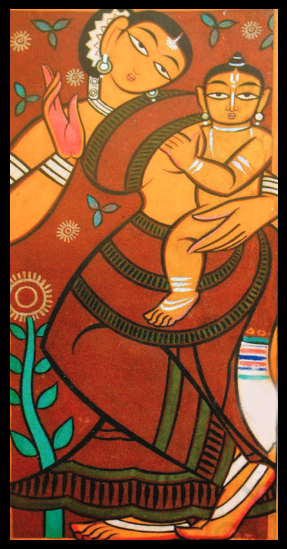
What type of painting is it?

What type of painting is it?

Answer & explanation+

Correct answer: option 1

The correct answer is Option 1- Gouache

Woman with Child: This is a gouache painting on paper made by Jamini Roy (1887–1972) in 1940. He was called the father of the folk renaissance in India, who created an alternative vision of modern Indian identity. In the mid –1920s, he travelled to the countryside of Bengal to collect folk paintings (pats) and learn from folk artisans. He wanted to learn from the expressive power of their lines. In this painting, a mother and her child are rendered with bold simplifications and thick outlines with sweeping brush strokes. The painting exudes a crude vigour hitherto unknown in Indian art. Figures are coloured in dull yellow and brick-red background, emulating the terracotta relief of his home village in Bankura. The two-dimensional nature of the painting is derived from pat paintings and his search for simplicity and pure form is visible. Roy borrowed volume, rhythm, decorative clarity and instrumentality of the pat in his artworks. To achieve and learn the purity of the pat, he first made many monochrome brush drawings, and then, gradually, moved to basic seven colours applied with tempera. He used Indian red, yellow ocher, cadmium green, vermilion, charcoal gray, cobalt blue and white made from organic material, such as rockdust, tamarind seeds, mercury powder, alluvial mud, indigo and common chalk. He used lamp black to outline the drawings and started making his own canvas with home-spun fabric (pats used paper or cloth or baked paper). Roy used the notion of village community as a weapon of resistance to colonial rule and a political act of making local signify national.

Advertisement

Practise more on The Bengal School and Cultural Nationalism

Chapter-wise mocks on the real NTA exam screen, with solutions and your rank. Your first mocks are free.

Start free mocks →

Advertisement

Next questions

  1. Vedanta, also known as Upanishads, belongs to which of the following periods?General Aptitude Test · General Knowledge
  2. Choose a statement that is incorrect for Khasi Matriliny Society:Sociology · Indian Society: Continuity and Change
  3. Petrol pump operation is considered as a lower order function in which country?Geography · Fundamentals of Human Geography: Human Settlements
  4. Arrange the following in order of occurrence.A. Green RevolutionB. Setting up of Planning CommissionC. Resolution which formed on the basis…Economics · Indian Economic Development: Indian Economy:1950-1990
  5. At what rate of interest will the present value of a perpetuity of Rs. 600 payable at the end of each quarter be Rs. 40,000?Applied Maths. Section B2 · Financial Mathematics
  6. Choose the most appropriate option to fill in the blank:The new washing machine will not start ______ you shut its lid firmly.English · Grammar: Conjunction
  7. Let A and B be two independent events such that P(A) = 0.4 and P(B) = 0.5 . (A) P(A ∩ B) = 0.2 (B) P(A ∪ B) = 0.9 (C) P(A|B) = 0.4 (D) P(A'…Maths. Section A · Probability (Section A)
  8. 'पतवार' किसे कहा जाता है?Hindi · Comprehension - (Poetry / Literary)
  9. On selling an article for ₹ 246.80 , the gain is 20 % more than the amount of loss incurred on selling it for ₹ 216 . If the article is sol…General Aptitude Test · Numerical Ability
  10. Identify the indicator which is not directly associated with the development of rural infrastructure of an Economy.Economics · Indian Economic Development: Infrastructure