CUETMOCK
  • Pricing
  • Mentors
Log inStart freeStart free mocks→

First test, then trust

Try a free CUET mock test.

Join 5,00,000+ students who rehearsed exam day on the exact NTA screen before sitting CUET. On the web and on Android.

Start free mocks →Get the Android app
CUETMOCK

India's #1 CUET Mock Test Platform. Original NCERT-based questions on the exact NTA exam screen — trusted by 5,00,000+ students since CUET 2022.

Get it onGoogle PlayScan to download the CUETMOCK app

Mock tests

  • CUET mock test series
  • Browse all papers
  • Commerce mocks
  • Humanities (Arts) mocks
  • Science mocks
  • Languages & GAT mocks
  • Free practice questions
  • Pricing

Resources

  • CUET exam guide
  • CUET syllabus
  • Universities accepting CUET
  • Expert blogs
  • News & notifications
  • Webinars & counselling
  • CUET score calculator
  • How we estimate your rank
  • FAQs

Company

  • About us
  • Our leadership & team
  • Our toppers
  • Mentors
  • For schools
  • Contact us
  • Terms
  • Privacy
  • Refund policy

Talk to us

+91 7696 6630 56info@cuetmock.comWhatsApp us

Our other platforms

  • JEE Mock — For IIT-JEE aspirants
  • NEET Mock — For NEET aspirants

Newsletter

Exam updates, study material and offers — no spam.

© 2026 NYC Ventures Pvt. Ltd.

701-702, Royal Business Park, Zirakpur, Punjab - 140603

  • Terms of use
  • Privacy policy
  • Refund policy
  • Contact us

iCUETMOCK is an independent preparation platform, not affiliated with the National Testing Agency (NTA). Always check exam details on the official NTA website.

  • Home
  • Mock tests
  • CUET guide
  • Pricing
  • Log in
Home/Practice questions/History
HistoryAncient India: Bricks, Beads and Bones

The Harappan urban culture belonged to:

The Harappan urban culture belonged to:

Answer & explanation+

Correct answer: option 3

The correct answer is Option (3) → Bronze age

An age is named after the most advanced material its people used for tools and other objects; each option is checked against what the Harappans used.

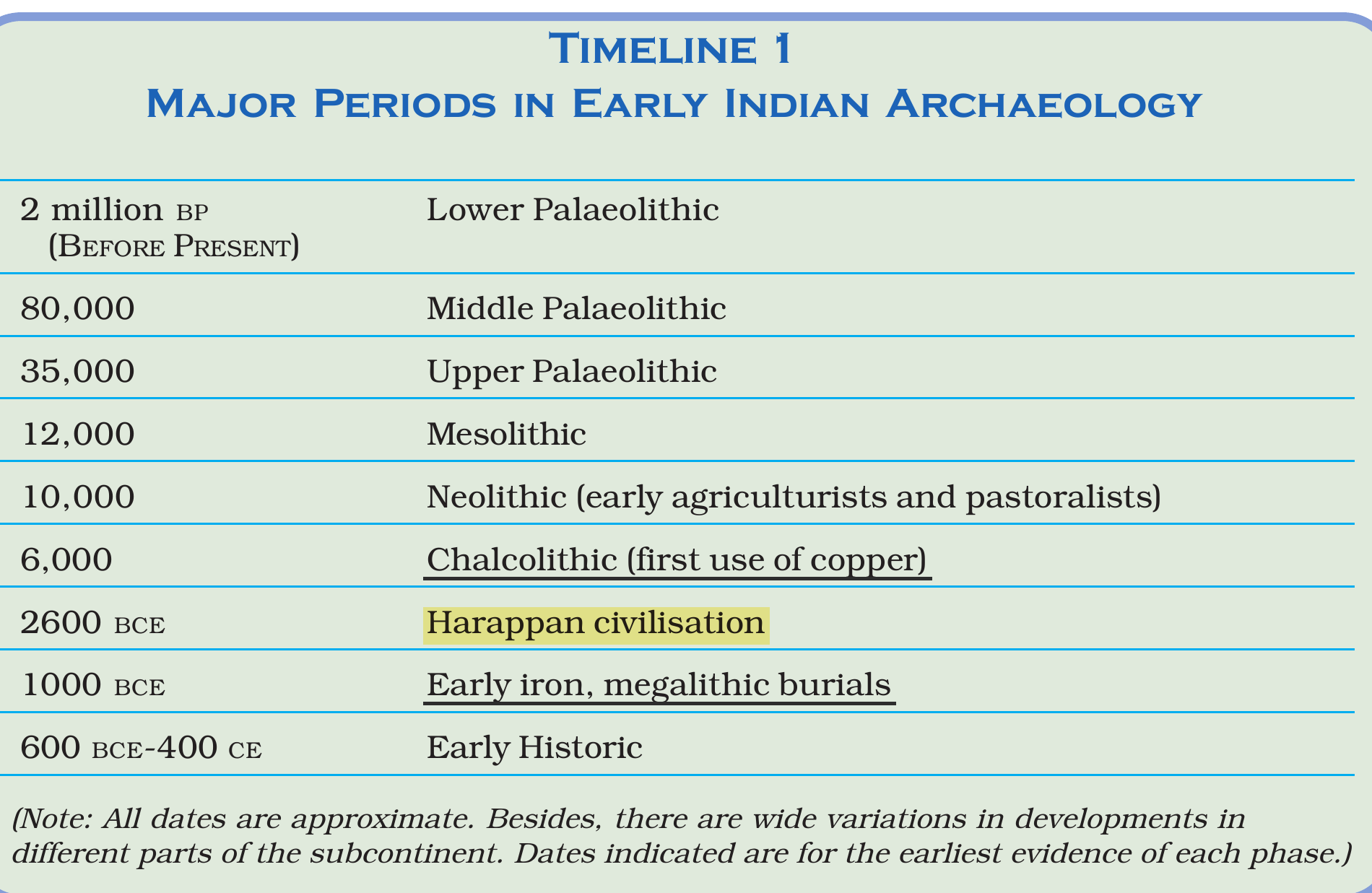
Option (1) Stone age — Incorrect. The periods when people used only stone tools, the Palaeolithic, Mesolithic and Neolithic, come long before the Harappan civilisation, whose people worked metals.

Option (2) Copper age — Incorrect. The Chalcolithic, the time of the first use of copper, comes before the Harappan civilisation. The Harappans used copper too, but they also made bronze articles, a further step.

Option (3) Bronze age — Correct. Harappan sites have yielded copper and bronze articles, tools and vessels; bronze was the most advanced metal the Harappans used, and they had no iron.

Option (4) Iron age — Incorrect. Early iron appears only around 1000 BCE, long after the Harappan civilisation of 2600 BCE.

Note: The terms ‘Stone Age’, ‘Copper Age’, ‘Bronze Age’ and ‘Iron Age’ are not used in NCERT (2026-27), which names the periods Palaeolithic to Neolithic, Chalcolithic, Harappan civilisation and early iron. Historians name an age after the most advanced material used for tools: bronze is an alloy of copper and tin, and since the Harappans worked copper and bronze but not iron, their urban culture belongs to the Bronze Age. This is explained here for the benefit of the students.


NCERT (2026-27): “Terminologies, Places and Time … The distinctive Harappan pottery, bricks (baked and unbaked) seals, weights, beads, copper and bronze articles, belonging to the Harappan civilisation have been found in the region, as apart as Afghanistan, Baluchistan, Sind and Punjab provinces of Pakistan and the Indian States of Jammu and Kashmir, Punjab, Haryana, Rajasthan, Uttar Pradesh, Gujarat and Maharashtra ….…”

NCERT extract

Advertisement

Practise more on Ancient India: Bricks, Beads and Bones

Chapter-wise mocks on the real NTA exam screen, with solutions and your rank. Your first mocks are free.

Start free mocks →

Advertisement

Next questions

  1. Physics · Semiconductors and Electronic Devices
  2. In order to differentiate between N-methylmethanamine and N,N-Dimethylmethanamine, the reaction to be used is:Chemistry · Organic: Amines
  3. If a - 24/a = 5, where a > 0, then the value of a^2 +64/(a^2) is :General Aptitude Test · Quantitative Reasoning
  4. How many triangles are present in the given figure?General Aptitude Test · Verbal Reasoning
  5. Let I = ∫_0^(π)/2 e^xsin x dx and J = ∫_0^(π)/2 e^xcos x dx . Which of the following statements are correct? (A) I + J = e^π/2 (B) I - J =…Maths. Section B1 · Definite Integration
  6. Which of the following is NOT a corner point of the feasible region determined by the constraints x + y ≤ 6 , x - y ≤ 2 , x ≥ 0 , y ≥ 0 ?Maths. Section B1 · Linear Programming
  7. Out of the given words, three are similar in a certain manner. However, one word is NOT like the other three. Select the word which is diff…General Aptitude Test · General Ability
  8. If sinα + cosecα = tan ( (π)/3 ) Find the value of (sin3α + cosec3α)General Aptitude Test · Quantitative Reasoning
  9. Rs 1500 is invested in two parts. The first part earns interest at 6% per annum and the second part at 5% per annum. If the total interest…General Aptitude Test · Numerical Ability
  10. अरे ! उसने तो कमाल कर दिया किस प्रकार का वाक्य है ?Hindi · व्याकरण - वाक्य