
In the reaction:
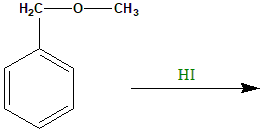
the product is:
Answer & explanation
Correct answer: option 3
The correct answer is Option (3) → C6H5CH2I + CH3OH
Ethers are cleaved by HI. The ether oxygen is first protonated, and then \( \ce{I^{-}} \) breaks one C–O bond. Which bond breaks depends on the alkyl groups:
The benzyl group can leave as the benzyl carbocation, \( \ce{C6H5CH2^{+}} \), which is stabilised by resonance with the ring (like a tertiary cation).
So the \( \ce{C6H5CH2-O} \) bond breaks (SN1 path), \( \ce{CH3OH} \) leaves, and \( \ce{I^{-}} \) joins the benzyl cation.
\( \ce{C6H5CH2-O-CH3 + HI -> C6H5CH2-\overset{+}{O}(H)-CH3 + I-} \)
\( \ce{C6H5CH2-\overset{+}{O}(H)-CH3 -> C6H5CH2+ + CH3OH} \)
\( \ce{C6H5CH2+ + I- -> C6H5CH2I} \)
Why the other options are incorrect
Option (1) C6H5CH2OCH3 + H2 — Incorrect. This shows the ether unchanged plus hydrogen gas; HI cleaves the ether and does not give \( \ce{H2} \).
Option (2) C6H5CH2OH + CH3I — Incorrect. This would come from \( \ce{I^{-}} \) attacking the methyl carbon by SN2; here the stable benzyl carbocation makes the benzyl–O bond the one that breaks.
Option (4) C6H5OH + CH3OH — Incorrect. Phenol would need a \( \ce{C6H5-O} \) ether (anisole); the compound here has a \( \ce{CH2} \) between the ring and oxygen, and no iodide product is shown.