A galvanic cell behaves as electrolytic cell when?
Answer & explanation
Correct answer: option 3
The correct answer is Option (3) → \(E_{ext} > E_{cell}\)
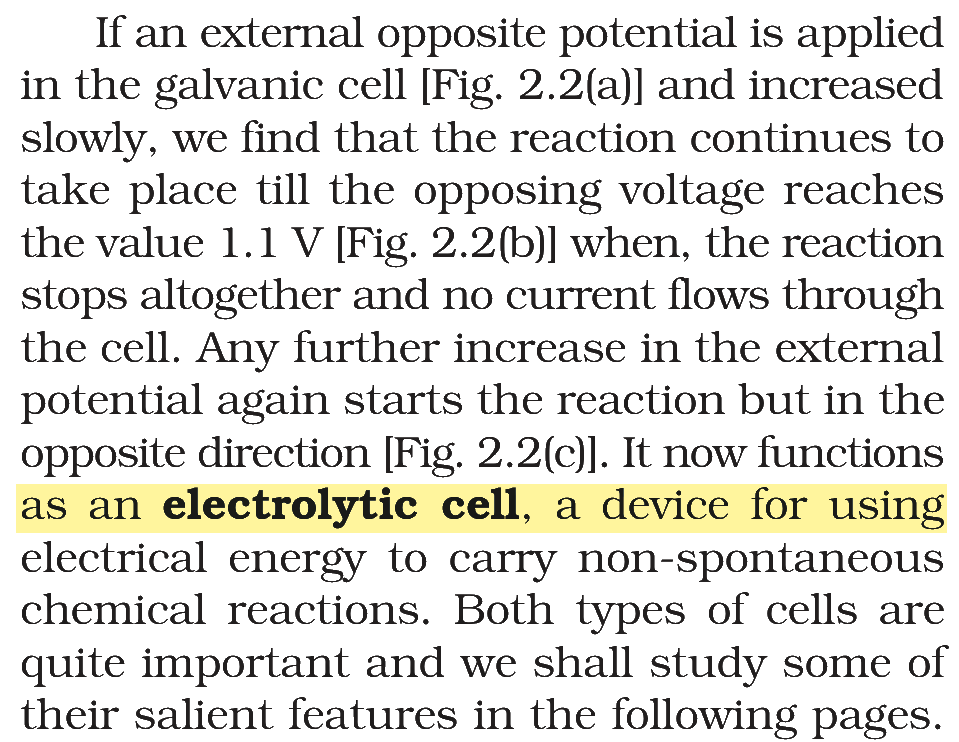
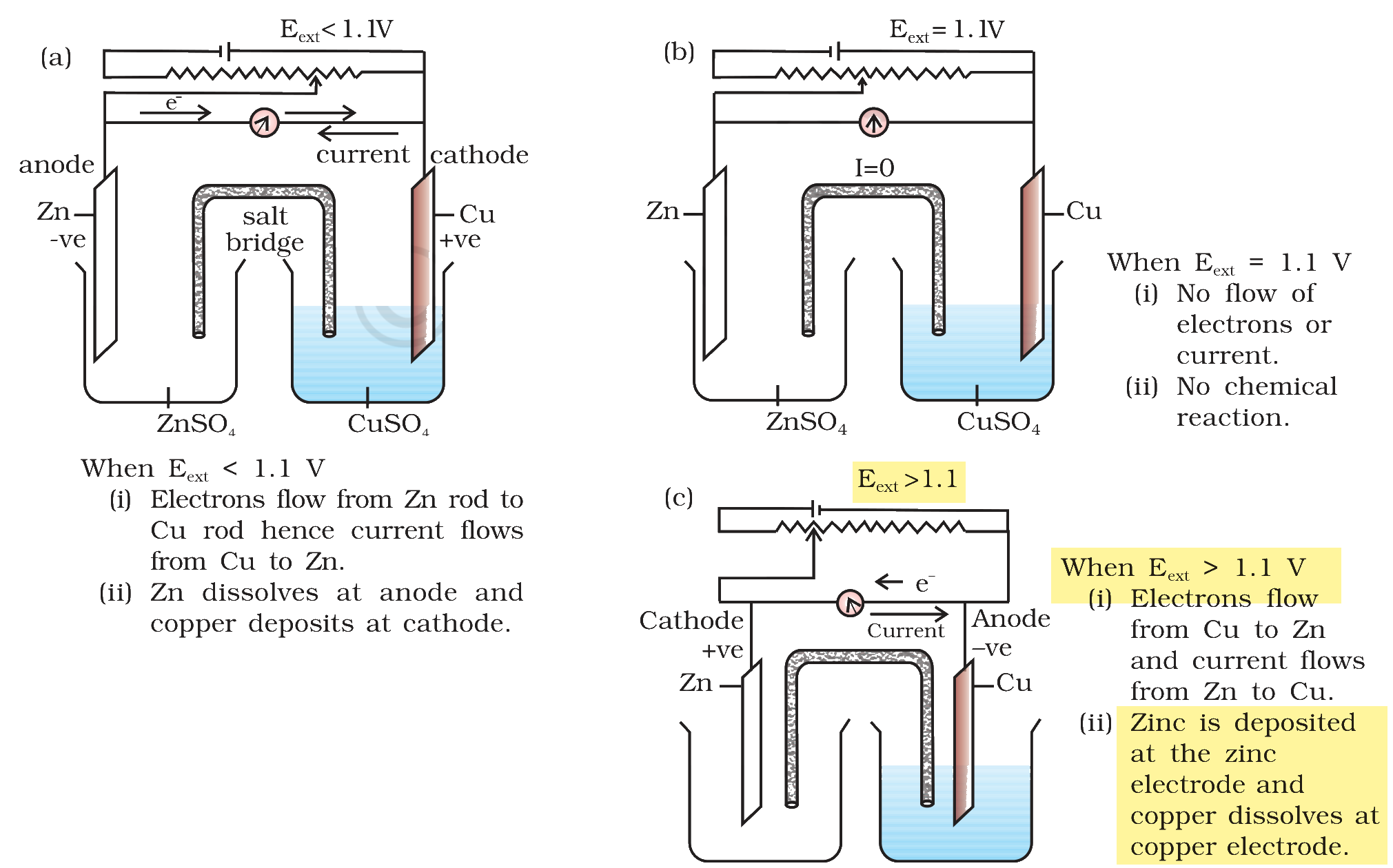
A galvanic cell produces a potential from a spontaneous reaction. When an external opposite potential greater than the cell potential is applied, the cell reaction runs in the opposite direction: zinc is deposited and copper dissolves. Electrical energy from outside now drives a non-spontaneous reaction, which is what an electrolytic cell does:
\( \displaystyle \ce{Zn^2+ + Cu -> Zn + Cu^2+} \quad (E_{ext} \gt 1.1\ \mathrm{V}) \)
So the galvanic cell behaves as an electrolytic cell when \( E_{ext} \gt E_{cell} \).
Why the other options are incorrect
Option (1) \(E_{cell} = E_{ext}\) — Incorrect. The two potentials balance, so no current flows and no reaction occurs.
Option (2) \(E_{cell} = 0\) — Incorrect. This is a cell at equilibrium (a dead cell); it neither gives nor uses current.
Option (4) \(E_{cell} > E_{ext}\) — Incorrect. The cell still wins, so it keeps working as a galvanic cell.
NCERT (2026-27 edition):
Electrochemical Cells – …