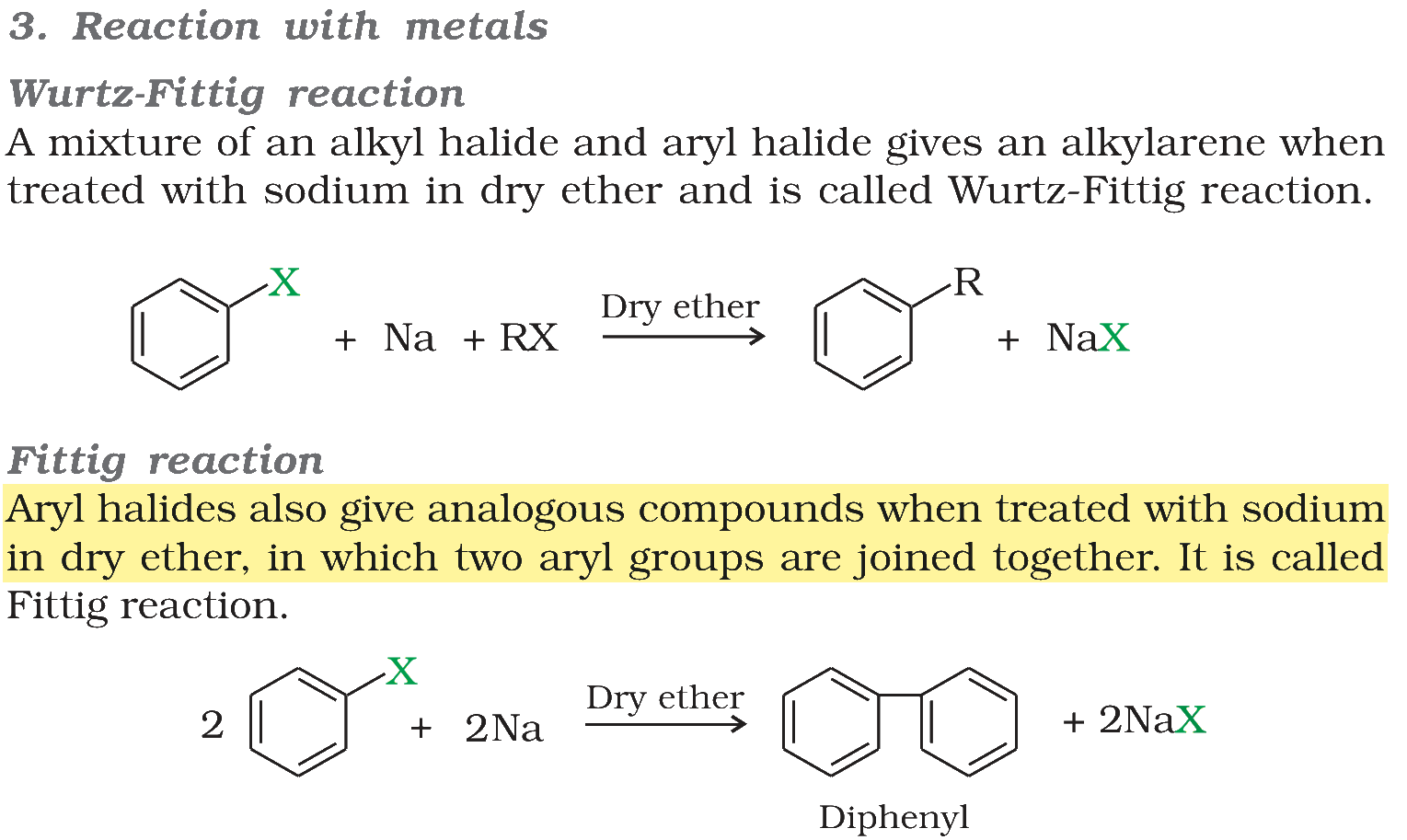
The reaction of two molecules of 1-chlorobenzene with sodium metal in the presence of dry ether to form diphenyl is known as
Answer & explanation
Correct answer: option 1
The correct answer is Option (1) → Fittig reaction
Sodium metal in dry ether joins two organic groups by removing their halogen atoms as sodium halide. The three coupling reactions are named by what is joined:
Wurtz reaction: two alkyl halides give an alkane.
\( \displaystyle \ce{2R-X + 2Na} \xrightarrow{\text{dry ether}} \ce{R-R + 2NaX} \)
Wurtz-Fittig reaction: an alkyl halide and an aryl halide give an alkylarene.
Fittig reaction: two aryl halides give a diaryl.
Here two molecules of chlorobenzene, an aryl halide, are joined to give diphenyl:
\( \displaystyle \ce{2C6H5Cl + 2Na} \xrightarrow{\text{dry ether}} \ce{C6H5-C6H5 + 2NaCl} \)
So this is the Fittig reaction.
Why the other options are incorrect
Option (2) Sandmeyer’s reaction — Incorrect. In this reaction the diazonium group of a benzenediazonium salt is replaced by Cl, Br or CN using a copper(I) salt; no sodium or second halide is involved:
\( \displaystyle \ce{C6H5N2+Cl-} \xrightarrow{\ce{Cu2Cl2/HCl}} \ce{C6H5Cl + N2} \)
Option (3) Grignard reagent reaction — Incorrect. A Grignard reagent is formed when a halide reacts with magnesium in dry ether; the carbon–halogen bond becomes a carbon–magnesium bond and no coupling takes place:
\( \displaystyle \ce{C6H5Br + Mg} \xrightarrow{\text{dry ether}} \ce{C6H5MgBr} \)
Option (4) Wurtz reaction — Incorrect. The Wurtz reaction couples two alkyl halides; here both halides are aryl halides.
NCERT (2026-27 edition):
Reaction with Metals