Consider the following reactions.
\( \displaystyle \ce{CH3Cl} \xrightarrow{\ce{KNO2}} \text{Product A} \)
\( \displaystyle \ce{CH3Cl} \xrightarrow{\ce{AgNO2}} \text{Product B} \)
In the above mentioned reactions, the reaction of chloromethane with KNO2 and AgNO2 afford two products: Products A and B, respectively. The Products A and B are:
Answer & explanation
Correct answer: option 2
The correct answer is Option (2) → Product A: CH3ONO Product B: CH3NO2
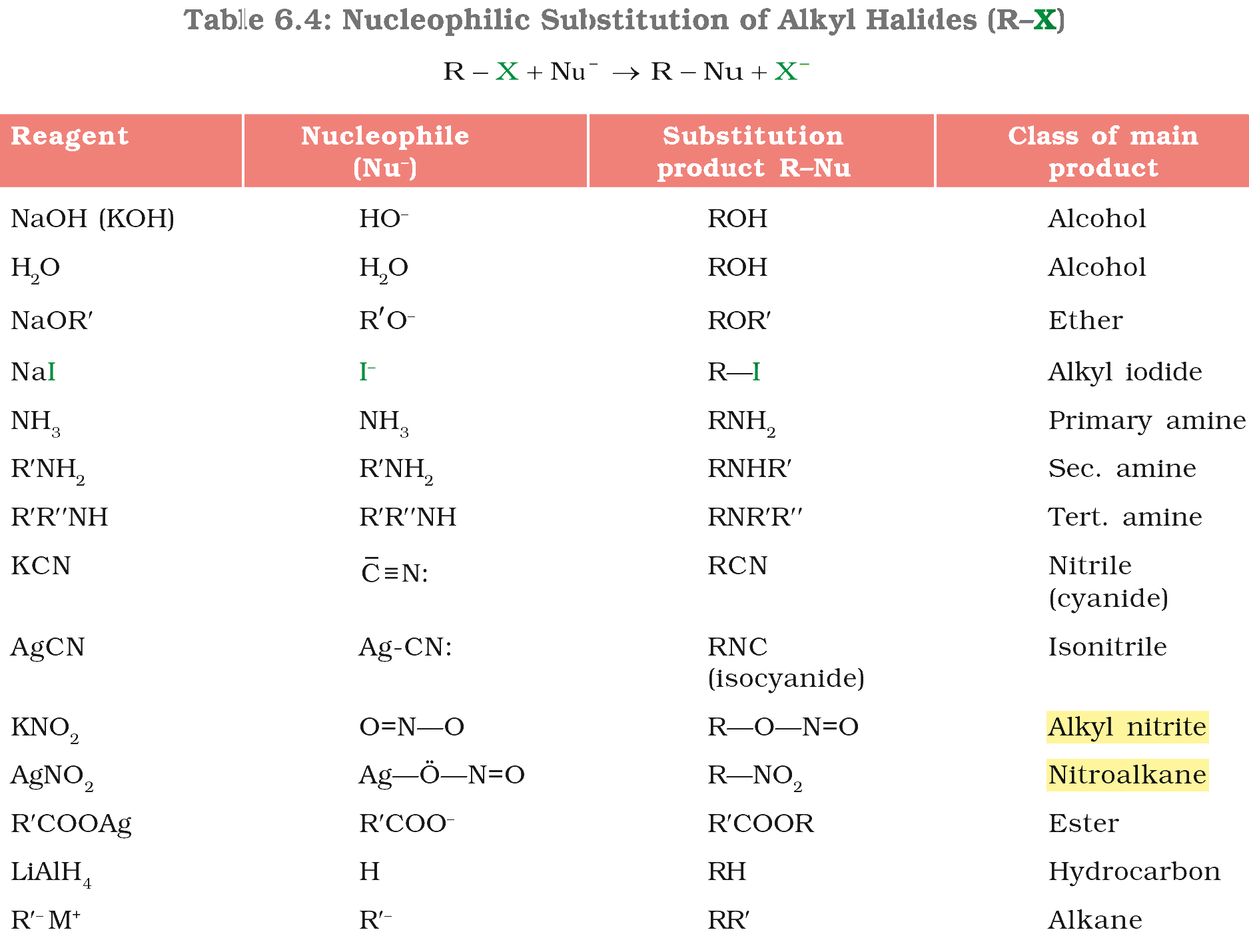
The nitrite ion is an ambident nucleophile: it can attack through oxygen or through nitrogen. Which atom attacks depends on the nature of the metal nitrite:
\( \ce{[O=N-O]^{-}} \) ↔ \( \ce{[^{-}O-N=O]} \)
KNO2 (ionic): it gives free NO2− ions. The attack takes place mainly through oxygen, which carries the negative charge, giving an alkyl nitrite (R–O–N=O).
AgNO2 (covalent): oxygen is bonded to silver (Ag–O–N=O), so only the lone pair on nitrogen is free to attack, giving a nitroalkane (\( \ce{R-NO2} \)).
\( \displaystyle \ce{CH3Cl + KNO2 -> CH3-O-N=O + KCl} \)
\( \displaystyle \ce{CH3Cl + AgNO2 -> CH3-NO2 + AgCl} \)
So product A is methyl nitrite, CH3ONO, and product B is nitromethane, CH3NO2.
Why the other options are incorrect
Option (1) Product A: CH3NO2 Product B: CH3NO2 — Incorrect. Ionic \( \ce{KNO2} \) gives the nitrite, not the nitro compound.
Option (3) Product A: CH3NO2 Product B: CH3ONO — Incorrect. The two products are swapped.
Option (4) Product A: CH3ONO Product B: CH3ONO — Incorrect. Covalent \( \ce{AgNO2} \) attacks through nitrogen, so it gives the nitro compound.
NCERT (2026-27 edition):
Reactions of Haloalkanes – …