Which of the following statements about the market supply curve is NOT correct?
Answer & explanation
Correct answer: option 3
The correct answer is Option (3) → It is obtained by adding up the prices at which different firms supply a given quantity.
The market supply curve adds the quantities that all firms supply at each price. It never adds prices.
Option (1) It is derived for a fixed number of firms in the market. — True. The curve holds only while the number of firms stays the same.
Option (2) It shifts to the right when the number of firms in the market increases. — True. More firms supply more at every price.
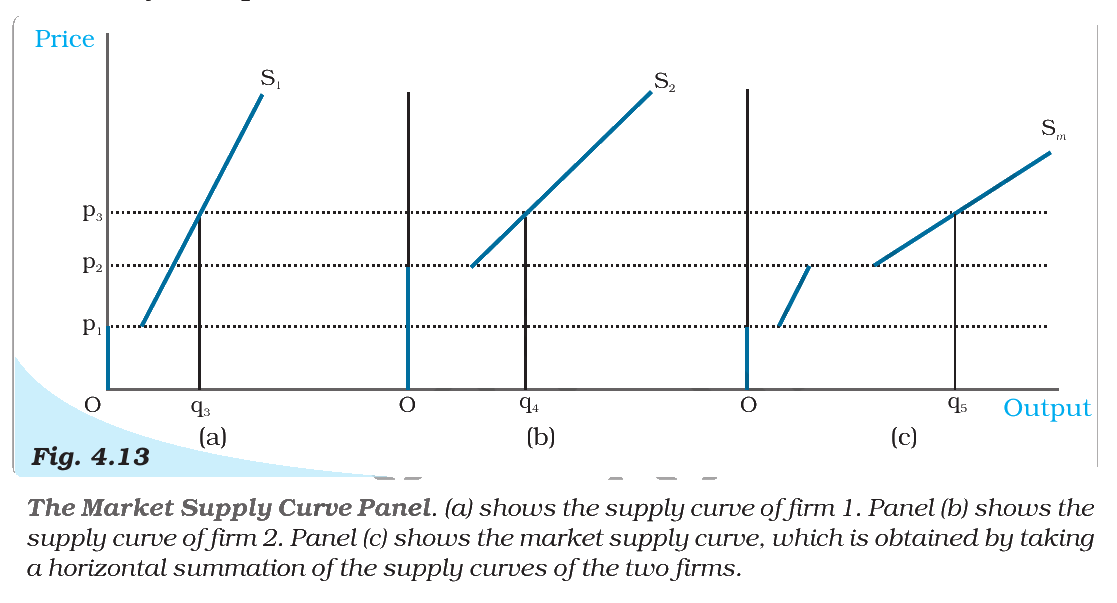
Option (3) It is obtained by adding up the prices at which different firms supply a given quantity. — False. At a given price the firms’ outputs are added, as q5 = q3 + q4. Adding prices gives nothing meaningful.
Option (4) It is obtained by the horizontal summation of the supply curves of individual firms. — True. Adding outputs at each price is a horizontal sum, along the output axis.
NCERT (2026-27): “4.6 Market Supply Curve … Given p3, firm 1 supplies q3 units of output while firm 2 supplies q4 units of output. So, the market supply at price p3 is q5, where q5 = q3 + q4. Notice how the market supply curve, Sm, in panel (c) is being constructed: we obtain Sm by taking a horizontal summation of the supply curves of the two firms in the market, S1 and S2.” “4.6 Market Supply Curve … It should be noted that the market supply curve has been derived for a fixed number of firms in the market. As the number of firms changes, the market supply curve shifts as well. Specifically, if the number of firms in the market increases (decreases), the market supply curve shifts to the right (left).”
|