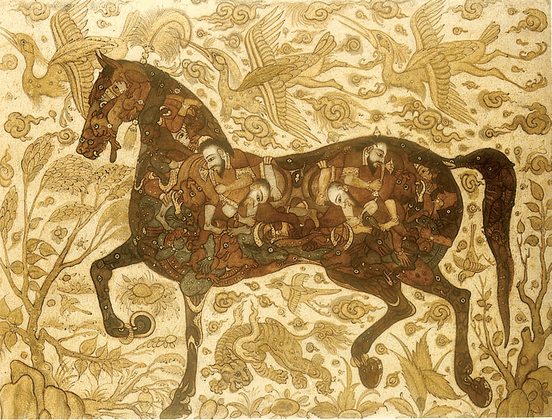
The Deccani painting Composite Horse, of the early seventeenth century, comes from which centre?
Answer & explanation
Correct answer: option 2
The correct answer is Option (2) → Golconda
Option (1) Bijapur — Incorrect. Bijapur is the centre of the Nujum al-Ulum and the Yogini, not of this painting.
Option (2) Golconda — Correct. Composite Horse, a galloping horse formed of intertwined human figures, is a painting from Golconda of the early seventeenth century.
Option (3) Hyderabad — Incorrect. Hyderabad is named in the chapter as the later State of Hyderabad under the Nizam; this painting is from Golconda, of the early seventeenth century.
Option (4) Ahmadnagar — Incorrect. Ahmadnagar has the earliest Deccani paintings, in a volume of poems on the reign of Hussain Nizam Shah I.
Note: This topic was not named in the CUET 2026 syllabus, but it was part of the NCERT chapter. In 2025 and 2026, NTA also asked questions on topics in NCERT that the CUET syllabus did not name. So our mocks have questions from every part of the NCERT chapter, to give you enough practice. Read the whole chapter, not only the sub-topics named in the syllabus.
NCERT (2026-27): “Composite Horse The painting is a curious mix of many artistic devices, which culminate as Composite Horse. The painting includes human figures intertwined in a manner that emerges as an extraordinary form of a galloping horse superimposed on a decorated background. Flying cranes and lions, Chinese clouds and plants with large leaves enhance the surreal element of this painting from Golconda, which is of early seventeenth century.”
|