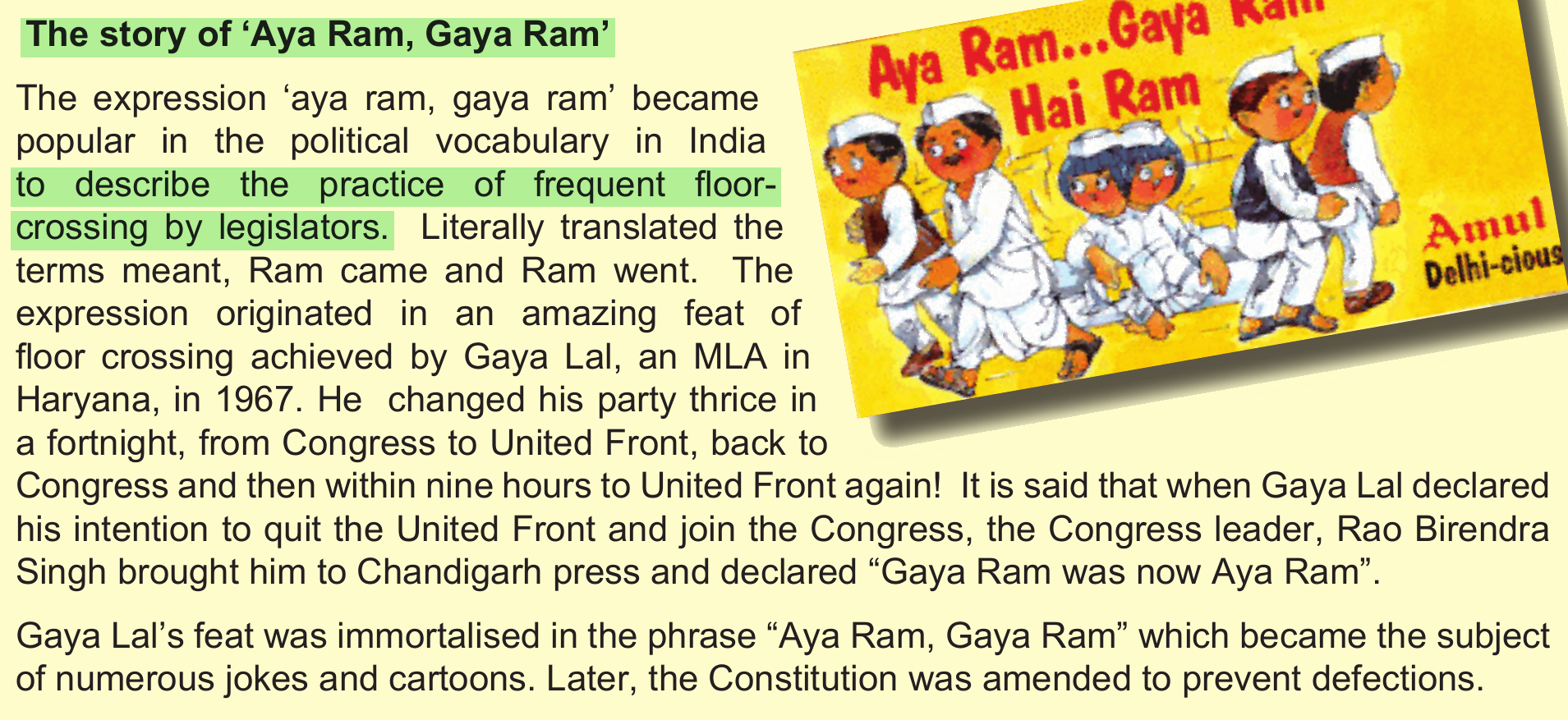
After Election of 1967, why was the slogan "Aya Ram, Gaya Ram" used in political vocabulary?
Answer & explanation
Correct answer: option 1
The correct answer is Option (1) → An elected representative left the party on whose symbol he/she was elected.
Option (1) An elected representative left the party on whose symbol he/she was elected. — Correct. This is defection. After the 1967 elections, constant realignments and shifting political loyalties gave rise to the expression ‘Aya Ram, Gaya Ram’, which describes the practice of frequent floor-crossing by legislators. It began with Gaya Lal, an MLA in Haryana, who changed his party thrice in a fortnight in 1967.
Option (2) They were present only a few times in Parliament — Incorrect.
Option (3) The elected members never came to the Parliament — Incorrect.
Option (4) Elected members didn’t care for voters. — Incorrect.
NCERT (2026-27): “Defection … Another important feature of the politics after the 1967 election was the role played by defections in the making and unmaking of governments in the States. Defection means an elected representative leaves the party on whose symbol he/she was elected and joins another party. After the 1967 general election, the breakaway Congress legislators played an important role in installing non-Congress governments in three States - Haryana, Madhya Pradesh and Uttar Pradesh. The constant realignments and shifting political loyalties in this period gave rise to the expression ‘Aya Ram, Gaya Ram’.…”
NCERT (2026-27), box ‘The story of Aya Ram, Gaya Ram’ |