
Figure shows a metal rod PQ resting on the rails AB and positioned between the poles of a permanent magnet. The rails, the rod and the magnetic field are in three mutual perpendicular directions. A galvanometer G connects the rails through a switch K. Length of the rod = 15 cm, B = 0.50 T, resistance of the closed loop containing the rod = \( 180.0\,\mathrm{m\Omega} \). Assume the field to be uniform.
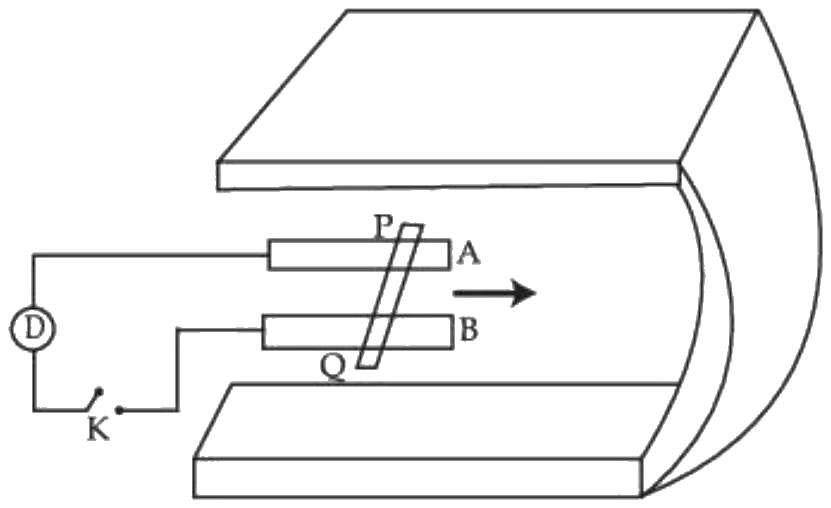
The induced emf produced in the moving rod if the magnetic field becomes parallel to the rails instead of being perpendicular will be:
Answer & explanation
Correct answer: option 4
The correct answer is Option (4) → Zero
The emf in a moving rod is the motional emf, \( \varepsilon = (\vec{v}\times\vec{B})\cdot\vec{l} \). It is non-zero only when the rod cuts the magnetic field lines.
The rod slides along the rails, so its velocity is parallel to the rails. If the field is also made parallel to the rails, then \( \vec{v} \) is parallel to \( \vec{B} \):
\( \displaystyle |\vec{v}\times\vec{B}| = v\,B\sin 0^\circ = 0 \)
\( \displaystyle \varepsilon = 0 \)
The rod now moves along the field lines and cuts none of them, so no emf is induced, whatever its speed.