
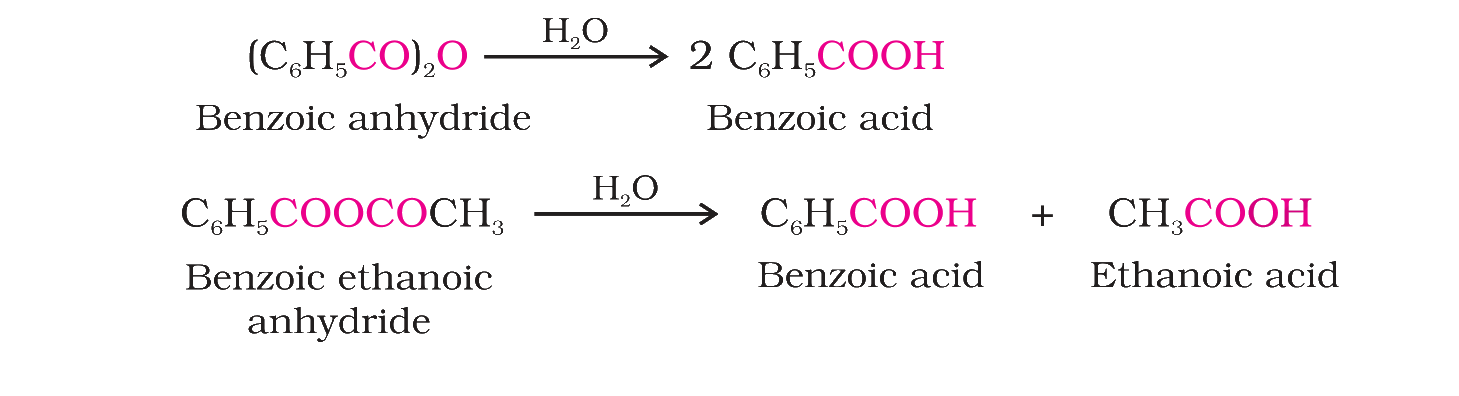
The figure shows the hydrolysis of two acid anhydrides.
Which of the following compounds, on hydrolysis with water in the same way, gives ethanoic acid and propanoic acid?
Answer & explanation
Correct answer: option 1
The correct answer is Option (1) → \( \ce{CH3COOCOC2H5} \)
The figure shows that water breaks the C–O–C link of an anhydride and each acyl group becomes a carboxylic acid. Benzoic anhydride has two benzoyl groups and gives two molecules of benzoic acid; benzoic ethanoic anhydride has two different acyl groups and gives two different acids.
\( \ce{CH3COOCOC2H5} \) has one ethanoyl group, \( \ce{CH3CO-} \), and one propanoyl group, \( \ce{C2H5CO-} \), joined through an oxygen atom, so it gives ethanoic acid and propanoic acid:
\( \displaystyle \ce{CH3COOCOC2H5 + H2O -> CH3COOH + C2H5COOH} \)
Why the other options are incorrect
Option (2) \( \ce{(CH3CO)2O} \) — Incorrect. Both acyl groups are ethanoyl groups, so it gives only ethanoic acid (two molecules).
Option (3) \( \ce{(C2H5CO)2O} \) — Incorrect. Both acyl groups are propanoyl groups, so it gives only propanoic acid (two molecules).
Option (4) \( \ce{CH3COOC2H5} \) — Incorrect. This is an ester, ethyl ethanoate, with only one acyl group. Its hydrolysis gives ethanoic acid and ethanol, not propanoic acid.
NCERT (2026-27 edition):
8.7 Methods of Preparation of Carboxylic Acids – “5. From acyl halides and anhydrides: … Anhydrides on the other hand are hydrolysed to corresponding acid(s) with water.”
Hydrolysis of acid anhydrides (8.7, from acyl halides and anhydrides)