Which of the following is the correct increasing order of acid strength?
Answer & explanation
Correct answer: option 4
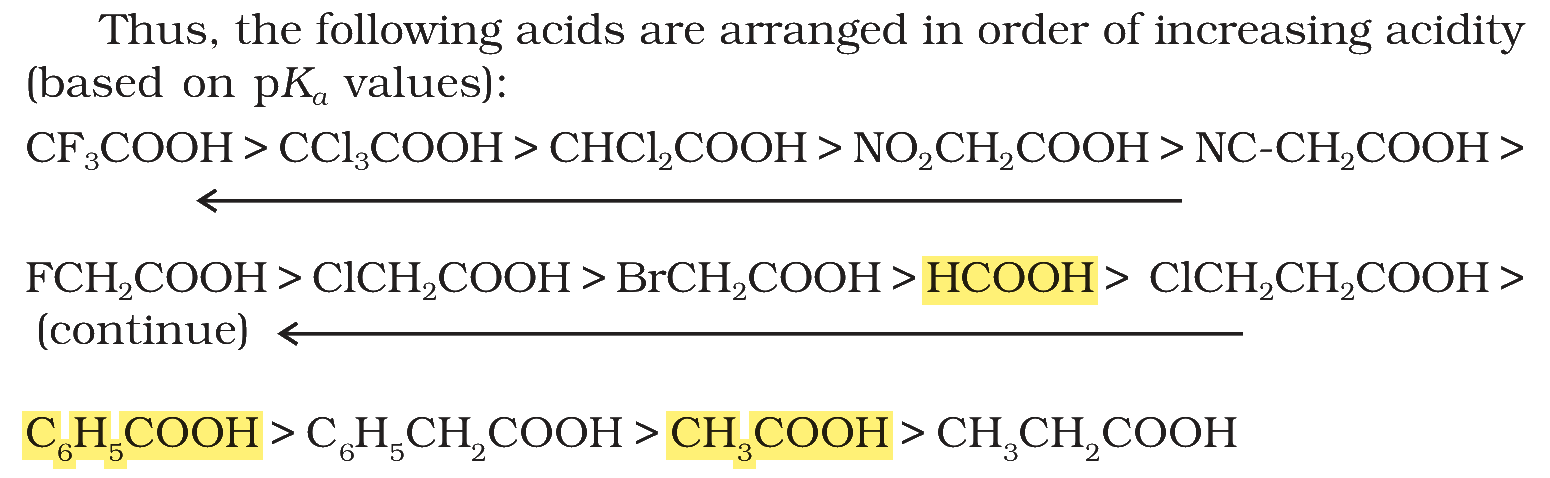
The correct answer is Option (4) → Acetic acid < Benzoic acid < Formic acid
A group that donates electrons to the carboxyl group destabilises the carboxylate ion and weakens the acid; a group that withdraws electrons stabilises it and strengthens the acid. The smaller the pKa, the stronger the acid.
Acetic acid, \( \ce{CH3COOH} \) — first (weakest). The electron-donating \( \ce{CH3} \) group destabilises the carboxylate ion; pKa is 4.76.
Benzoic acid, \( \ce{C6H5COOH} \) — second. The carboxyl carbon is attached to an sp2 hybridised carbon, which is more electronegative; this raises the acidity above that of acetic acid (pKa 4.19).
Formic acid, \( \ce{HCOOH} \) — third (strongest). The carboxyl group carries only an H atom and no electron-donating group; in the acid series arranged by pKa it stands above both benzoic acid and acetic acid.
In that series the sign > means “stronger acid than”, so the strongest acid is written first.
NCERT (2026-27 edition):
8.9.1 Reactions Involving Cleavage of O–H Bond – “Direct attachment of groups such as phenyl or vinyl to the carboxylic acid, increases the acidity of corresponding carboxylic acid, contrary to the decrease expected due to resonance effect … This is because of greater electronegativity of sp2 hybridised carbon to which carboxyl carbon is attached.”