
The nomenclature of the complex \( [CuCl_2(CH_3NH_2)_2] \) is
Answer & explanation
Correct answer: option 4
The correct answer is Option (4) → Dichlorobis(methylamine)copper(II)
A coordination compound is named by writing the ligands in alphabetical order, then the metal with its oxidation state in Roman numerals. Anionic ligands end in -o (chloro, now written chlorido); neutral ligands keep their names. When a ligand name already contains a numerical prefix or is a long name such as methylamine, the number is given by bis, tris, with the ligand name in parentheses. A neutral complex takes the plain name of the metal.
For \( \ce{[CuCl2(CH3NH2)2]} \):
ligands: two \( \ce{Cl-} \), dichloro; two methylamine, bis(methylamine)
alphabetical order: chloro before methylamine (prefixes di and bis are ignored)
oxidation state of Cu: the complex is neutral
\( \displaystyle x + 2(-1) + 2(0) = 0 \Rightarrow x = +2 \)
So the name is dichlorobis(methylamine)copper(II).
Why the other options are incorrect
Option (1) Bis(methylamine)dichlorocopper(I) — Incorrect. Two errors: methylamine is placed before chloro, which breaks the alphabetical order, and copper is +2, not +1.
Option (2) Dichlorido(methylamine)copper(I) — Incorrect. It shows only one methylamine (the bis is missing) and the wrong oxidation state, +1.
Option (3) Bis(methylamine)dichlorocopper(II) — Incorrect. The oxidation state is right, but the ligands are not in alphabetical order.
NCERT (2026-27 edition):
Naming of Mononuclear Coordination Compounds – …
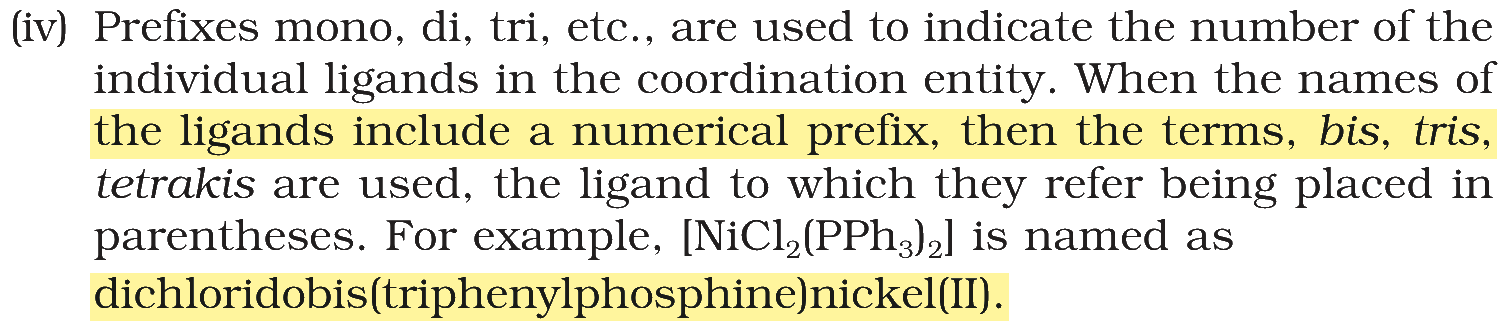
Naming of Mononuclear Coordination Compounds – “… (ii) The ligands are named in an alphabetical order before the name of the central atom/ion. (This procedure is reversed from writing formula).
… (v) Oxidation state of the metal in cation, anion or neutral coordination entity is indicated by Roman numeral in parenthesis.”