
CUETMOCK
  • Pricing
  • Mentors
Log inStart freeStart free mocks→

First test, then trust

Try a free CUET mock test.

Join 5,00,000+ students who rehearsed exam day on the exact NTA screen before sitting CUET. On the web and on Android.

Start free mocks →Get the Android app
CUETMOCK

India's #1 CUET Mock Test Platform. Original NCERT-based questions on the exact NTA exam screen — trusted by 5,00,000+ students since CUET 2022.

Get it onGoogle PlayScan to download the CUETMOCK app

Mock tests

  • CUET mock test series
  • Commerce mocks
  • Humanities (Arts) mocks
  • Science mocks
  • Languages & GAT mocks
  • Free practice questions
  • Pricing

Resources

  • CUET exam guide
  • CUET syllabus
  • Universities accepting CUET
  • Expert blogs
  • News & notifications
  • Webinars & counselling
  • CUET score calculator
  • How we estimate your rank
  • FAQs

Company

  • About us
  • Our leadership & team
  • Our toppers
  • Mentors
  • For schools
  • Contact us
  • Terms
  • Privacy
  • Refund policy

Talk to us

+91 7696 6630 56info@cuetmock.comWhatsApp us

Our other platforms

  • JEE Mock — For IIT-JEE aspirants
  • NEET Mock — For NEET aspirants

Newsletter

Exam updates, study material and offers — no spam.

© 2026 NYC Ventures Pvt. Ltd.

701-702, Royal Business Park, Zirakpur, Punjab - 140603

  • Terms of use
  • Privacy policy
  • Refund policy
  • Contact us

iCUETMOCK is an independent preparation platform, not affiliated with the National Testing Agency (NTA). Always check exam details on the official NTA website.

  • Home
  • Mock tests
  • CUET guide
  • Pricing
  • Log in
Home/Practice questions/Chemistry
ChemistryInorganic: Coordination Compounds

Consider the following statements about the cobalt(III) chloride–ammo…

Consider the following statements about the cobalt(III) chloride–ammonia complexes studied by Werner.

(A) 1 mol of the yellow complex, CoCl3.6NH3, gives 3 mol of AgCl with an excess of silver nitrate solution in cold.

(B) In the purple complex, CoCl3.5NH3, two chloride ions are bound to cobalt inside the square brackets.

(C) The green and the violet complexes have identical empirical formula, CoCl3.4NH3, but distinct properties.

(D) The solution conductivity of the violet complex corresponds to a 1:2 electrolyte.

(E) In each of the four complexes, the secondary valence of cobalt is six.

Which of the statements given above are incorrect? Choose the correct answer from the options given below:

Answer & explanation+

Correct answer: option 2

The correct answer is Option (2) → (B) and (D) only

Werner explained the AgCl and conductivity results by keeping six groups bound to cobalt inside a square bracket. Only the chloride ions outside the bracket are precipitated as AgCl or move as free ions in solution.

(A) 1 mol of the yellow complex, CoCl3.6NH3, gives 3 mol of AgCl with an excess of silver nitrate solution in cold. — Correct statement. The yellow complex is \( \ce{[Co(NH3)6]^3+ 3Cl-} \). All three chloride ions are outside the bracket, so all three are precipitated.

(B) In the purple complex, CoCl3.5NH3, two chloride ions are bound to cobalt inside the square brackets. — Incorrect statement. The purple complex gives 2 mol AgCl, so two chloride ions are outside the bracket. Table 5.1 formulates it as \( \ce{[CoCl(NH3)5]^2+ 2Cl-} \), with only one chloride ion bound to cobalt.

(C) The green and the violet complexes have identical empirical formula, CoCl3.4NH3, but distinct properties. — Correct statement. Both are formulated as \( \ce{[CoCl2(NH3)4]^+ Cl-} \) and differ in colour. Such compounds are isomers.

(D) The solution conductivity of the violet complex corresponds to a 1:2 electrolyte. — Incorrect statement. The violet complex, \( \ce{[CoCl2(NH3)4]^+ Cl-} \), has only one chloride ion outside the bracket. Table 5.1 lists its solution conductivity as that of a 1:1 electrolyte.

(E) In each of the four complexes, the secondary valence of cobalt is six. — Correct statement. In every complex six groups (chloride ions, ammonia molecules or both) are bound directly to cobalt.

NCERT (2026-27 edition):
5.1 Werner’s Theory of Coordination Compounds – “1 mol CoCl3.6NH3 (Yellow) gave 3 mol AgCl
1 mol CoCl3.5NH3 (Purple) gave 2 mol AgCl
1 mol CoCl3.4NH3 (Green) gave 1 mol AgCl
1 mol CoCl3.4NH3 (Violet) gave 1 mol AgCl”

“…the compounds are formulated as shown in Table 5.1, where the atoms within the square brackets form a single entity which does not dissociate under the reaction conditions. Werner proposed the term secondary valence for the number of groups bound directly to the metal ion; in each of these examples the secondary valences are six.”

“Note that the last two compounds in Table 5.1 have identical empirical formula, CoCl3.4NH3, but distinct properties. Such compounds are termed as isomers.”
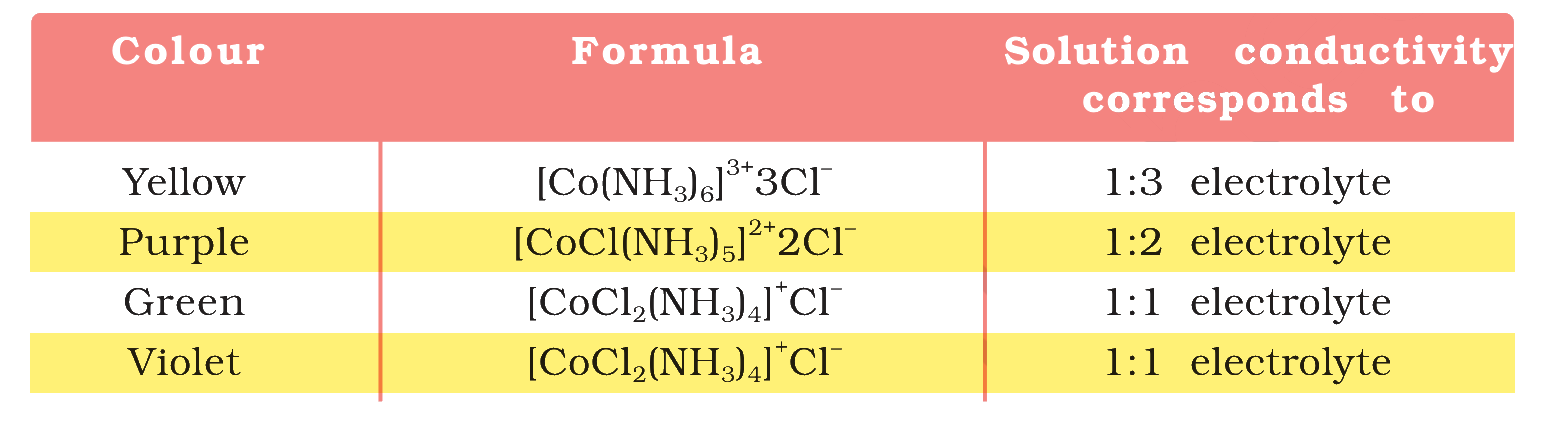
Table 5.1

Table 5.1: Formulation of Cobalt(III) Chloride-Ammonia Complexes

Advertisement

Practise more on Inorganic: Coordination Compounds

Chapter-wise mocks on the real NTA exam screen, with solutions and your rank. Your first mocks are free.

Start free mocks →

Advertisement

Next questions

  1. Re-arrange the following sentences to create a meaningful paragraph. A. As a child, he became interested in martial arts.B. His mother supp…English · Arrange in Meaningful Sequence
  2. Green Revolution helped increase in the production of ____________.Economics · Indian Economic Development: Indian Economy:1950-1990
  3. Chemistry · Inorganic: Coordination Compounds
  4. Which of the following phenomenon is responsible for the reddish appearance of sun during sunset or sunrise?Physics · Ray Optics
  5. Which of the following Congress leaders lost the elections from their constituency in the Fourth general elections?Political Science · Politics in India Since Independence: Challenges to and Restoration of the Congress System
  6. Which of the following is used in the making of unbreakable cups?Chemistry · Organic: Polymers
  7. What does LTTE stand for in reference to India and Sri Lanka?Political Science · Contemporary World Politics: Contemporary South Asia
  8. Ravi and Kunal are good in Hockey and Volleyball. Sachin and Ravi are good in Hockey and Baseball. Gaurav and Kunal are good in Cricket and…General Aptitude Test · Verbal Reasoning
  9. Select the statements that are CORRECT regarding patterns of biodiversity.(A) Species diversity increases as we move away from the equator…Biology · Biodiversity and Conservation
  10. Arjun is asked how true statements such as 'I am good at homework' are for him. Consider the following statements:(A) The value judgment Ar…Psychology · Self and Personality