Which of the following phenomenon is responsible for the reddish appearance of sun during sunset or sunrise?
Answer & explanation
Correct answer: option 3
The correct answer is Option (3) → Scattering of light
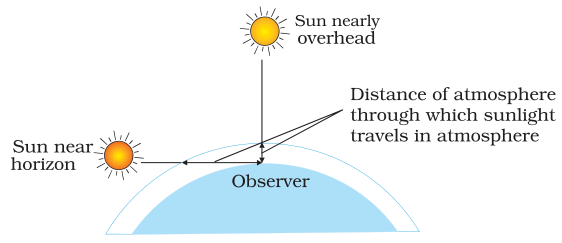
The scattering of sunlight by the molecules of the atmosphere is far stronger for short wavelengths than for long ones (Rayleigh scattering, proportional to \( 1/\lambda^{4} \)). At sunrise and sunset the sunlight travels a much longer path through the atmosphere, so almost all the blue light is scattered out of the beam and mainly red light reaches the eye.
Dispersion, total internal reflection and refraction through a prism do not remove the blue light from the direct beam, so they cannot make the Sun look red.
Note: This question is from the pre-rationalised NCERT book (2022-23). The topic was removed from the latest NCERT book (2026-27), and it also appears to be out of the CUET 2026 syllabus.
NCERT (Pre-rationalised edition, 2022-23):
Scattering of Light – “… At sunset or sunrise, the sun’s rays have to pass through a larger distance in the atmosphere (Fig. 9.28). Most of the blue and other shorter wavelengths are removed by scattering. The least scattered light reaching our eyes, therefore, the sun looks reddish. This explains the reddish appearance of the sun and full moon near the horizon.”