
CUETMOCK
  • Pricing
  • Mentors
Log inStart freeStart free mocks→

First test, then trust

Try a free CUET mock test.

Join 5,00,000+ students who rehearsed exam day on the exact NTA screen before sitting CUET. On the web and on Android.

Start free mocks →Get the Android app
CUETMOCK

India's #1 CUET Mock Test Platform. Original NCERT-based questions on the exact NTA exam screen — trusted by 5,00,000+ students since CUET 2022.

Get it onGoogle PlayScan to download the CUETMOCK app

Mock tests

  • CUET mock test series
  • Commerce mocks
  • Humanities (Arts) mocks
  • Science mocks
  • Languages & GAT mocks
  • Free practice questions
  • Pricing

Resources

  • CUET exam guide
  • CUET syllabus
  • Universities accepting CUET
  • Expert blogs
  • News & notifications
  • Webinars & counselling
  • CUET score calculator
  • How we estimate your rank
  • FAQs

Company

  • About us
  • Our leadership & team
  • Our toppers
  • Mentors
  • For schools
  • Contact us
  • Terms
  • Privacy
  • Refund policy

Talk to us

+91 7696 6630 56info@cuetmock.comWhatsApp us

Our other platforms

  • JEE Mock — For IIT-JEE aspirants
  • NEET Mock — For NEET aspirants

Newsletter

Exam updates, study material and offers — no spam.

© 2026 NYC Ventures Pvt. Ltd.

701-702, Royal Business Park, Zirakpur, Punjab - 140603

  • Terms of use
  • Privacy policy
  • Refund policy
  • Contact us

iCUETMOCK is an independent preparation platform, not affiliated with the National Testing Agency (NTA). Always check exam details on the official NTA website.

  • Home
  • Mock tests
  • CUET guide
  • Pricing
  • Log in
Home/Practice questions/Chemistry
ChemistryInorganic: Coordination Compounds

What is IUPAC name of complex ion [Ag(CN)2]- ?

Coordination compounds

The coordination compounds are very important in biological systems (like human, plant and animal's body), metallurgy, analytical chemistry, medicine etc. Chlorophyll, Hemoglobin, vitamin B12 etc. are coordination compounds of various metals. They are also called complex compounds and formed by two main entities, metal and ligands. Some ligands are Poly-dentate, like EDTA, which is used in the estimation of hardness of water with Ca2+ and Mg2+ ions. Gold and silver make [Au(CN)2]− and [Ag(CN)2]− type complex ions in aqueous solution during extraction of metals. In photography, developing film form a complex ion [Ag (S2O3)2]3−. A complex compound of platinum (Pt), cis-platin is used in the treatment of cancer. Some metals can be refined by making their complex compounds, like impure Nickel is converted to [Ni(CO)4] complex. All these coordination compounds may be colored or colorless, paramagnetic or diamagnetic, low spin or high spin, and arranged in particular geometry and hybridization. Isomerism is shown by these complexes due to different arrangement of ligands around the central metal atom.

What is IUPAC name of complex ion [Ag(CN)2]- ?

Answer & explanation+

Correct answer: option 3

The correct answer is Option (3) → Dicyanidoargentate(I) ion

In IUPAC naming of a complex ion, the ligands are named first and then the metal. The anionic ligand \( \ce{CN^{-}} \) is named cyanido, with di- for two ligands. The oxidation state of the metal is shown in Roman numerals. In an anionic complex, the metal name ends in “-ate”, and silver takes its Latin name, argentate.

For the oxidation state of silver in \( \ce{[Ag(CN)2]^{-}} \):

    \( \displaystyle x+2(-1)=-1\ \Rightarrow\ x=+1 \)

So the name is dicyanidoargentate(I) ion.

Why the other options are incorrect

  • Option (1) Dicyanosilverate (I) ion — Incorrect. In anionic complexes, silver is always named by its Latin name, argentate; “silverate” is never used. Also, the ligand must be named cyanido, not cyano.

  • Option (2) Dicyanosilverate(II) ion — Incorrect. Silver is in the +1 state, not +2, and the name must use argentate.

  • Option (4) Dicyanidoargentate(II) ion — Incorrect. The name is correct except the oxidation state: silver is +1 here, not +2.

NCERT (2026-27 edition):
Naming of Mononuclear Coordination Compounds – …
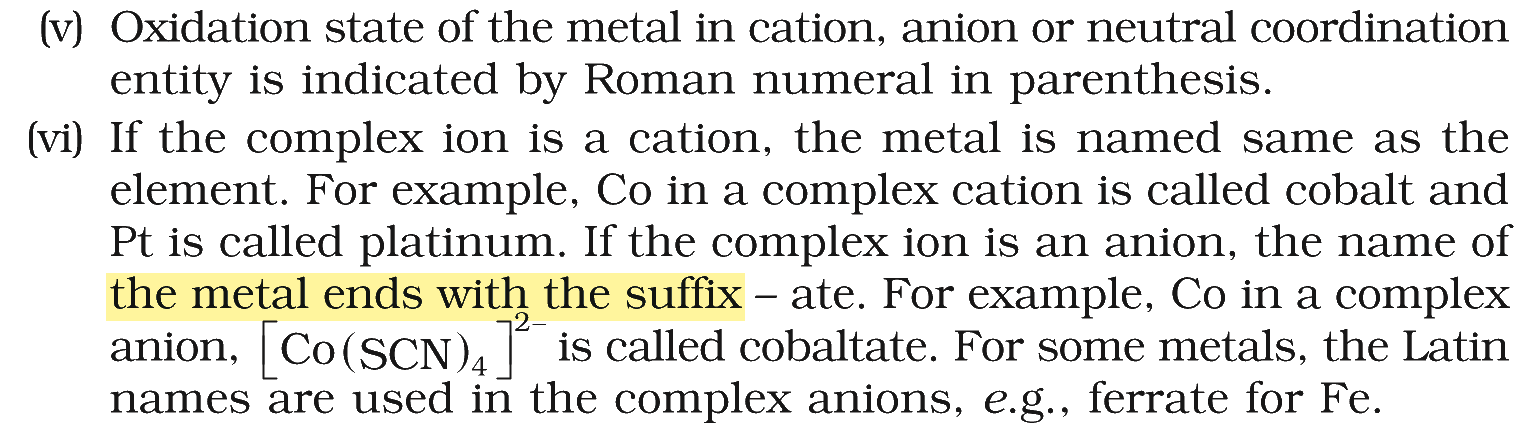
Textbook extract

Naming of Mononuclear Coordination Compounds – “… 3. [Ag(NH3)2][Ag(CN)2] is named as: diamminesilver(I) dicyanidoargentate(I)”

Advertisement

Practise more on Inorganic: Coordination Compounds

Chapter-wise mocks on the real NTA exam screen, with solutions and your rank. Your first mocks are free.

Start free mocks →

Advertisement

Next questions

  1. Suresh takes a loan of Rs. 4,00,000 with 10% annual interest rate for 5 years on flat rate basis. Which of the following statements are cor…Applied Maths. Section B2 · Financial Mathematics
  2. “There are various theories of management, as propounded by many thinkers, which prescribe certain universal principles. Management applies…Business Studies · Nature and significance of Management
  3. Match List-I with List-IIList-IReaction/ ConstantList-IIUnit(A) Zero order reaction(I) mol-1 L s-1(B) First order reaction(II) cal K-1 mol-…Chemistry · Physical: Chemical Kinetics
  4. Resilience has recently been defined in terms of three resources. I have, I am and __________.Psychology · Meeting Life Challenges
  5. Match the LIST-I with LIST-IILIST-I(Intercontinental Railway)LIST-II(Station)A.Trans Siberian RailwayI.Broken HillB.Trans Canadian RailwayI…Geography · Fundamentals of Human Geography: Transport and Communication
  6. If y=500e^7x+600e^-7x , then (d^2y)/(dx^2) equals :Maths. Section A · Continuity and Differentiability (Section A)
  7. Who among the following was the most successful artist of the academic realism?Fine Arts · The Bengal School and Cultural Nationalism
  8. Anil and Uday are partners sharing profits equally. Arvind is admitted as a new partner. He brings Rs. 1,00,000 only out of his share of go…Accountancy Part A · Admission of a Partner
  9. How many minutes does Siddharth take to cover a distance of 500 m, if he runs at a speed of 15 km/hr?General Aptitude Test · Numerical Ability
  10. A motorboat can travel 10 km against the stream in 30 minutes and returns back at the same point in 10 minutes. The speed of the stream is,Applied Maths. Section B2 · Numbers, Quantification and Numerical Applications