Read the passage carefully and answer the given questions.
Recombinant DNA Technology
Asexual reproduction preserves the genetic information, while sexual reproduction permits variation. Traditional hybridization procedures used in plants and animals breeding very often lead to inclusion and multiplication of undesirable genes along with the desired genes. The techniques of genetic engineering, which include creation of recombinant DNA, use of gene cloning and gene transfer, overcome this limitation and allow us to isolate and introduce only one or a set of desirable genes without introducing undesirable genes into the target organism.
Which one of the following options is correct for working of restriction enzymes?
Answer & explanation
Correct answer: option 4
The correct answer is Option (4) → Cuts DNA at specific sequence
Option (1) A tool used to insert DNA into the cells — Incorrect. DNA is put into host cells by other means: a vector, or methods such as microinjection, the gene gun or making bacteria competent. A restriction enzyme does not carry DNA anywhere.
Option (2) Enzyme used to join DNA fragments — Incorrect. Joining the cut ends of DNA is the work of DNA ligase. The restriction enzyme does the opposite job; it cuts.
Option (3) Used as vector — Incorrect. A vector is a DNA molecule that carries the foreign gene and replicates in the host, such as a plasmid or a bacteriophage. An enzyme is a protein and cannot act as a vector.
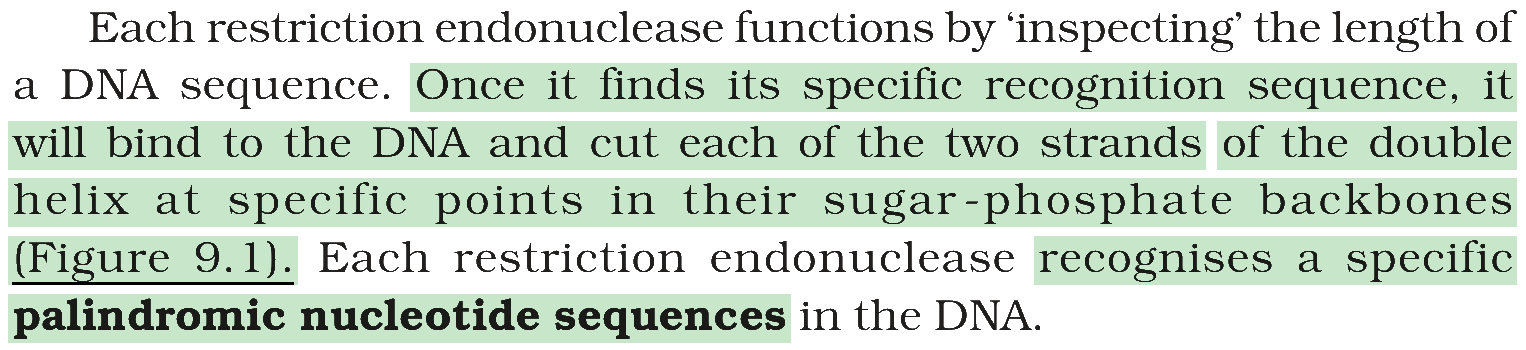
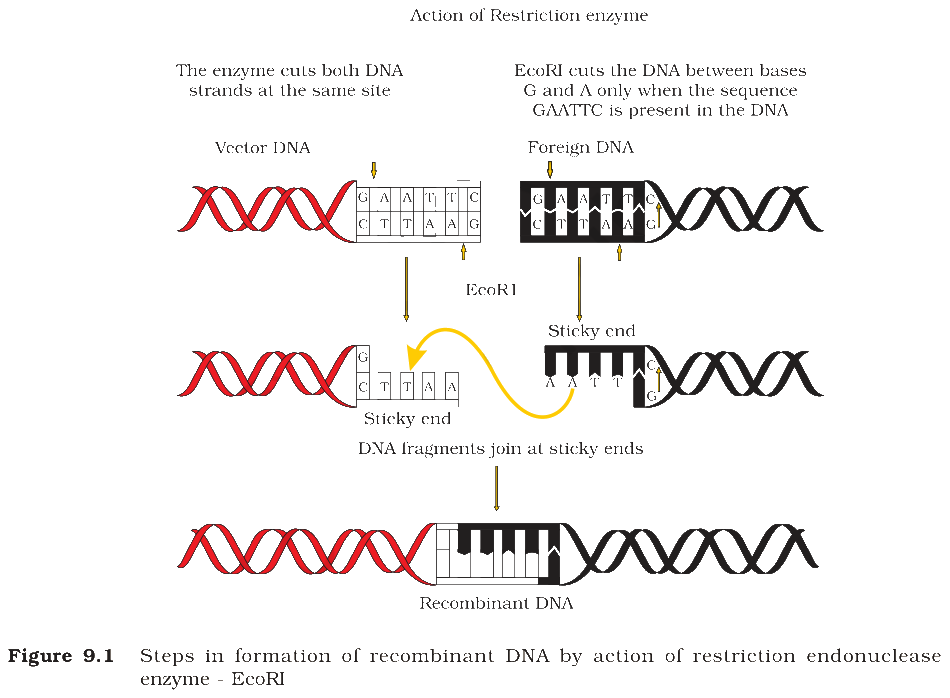
Option (4) Cuts DNA at specific sequence — Correct. A restriction enzyme is a ‘molecular scissors’. Each one cuts DNA only where it finds its own recognition sequence, so the same piece of DNA is cut out every time.
Note: This passage is taken from NCERT as it is. Most CUET (UG) questions come straight from NCERT, so study the book line by line, including figures and their titles.
NCERT Extract:
Restriction Enzymes – …