CUETMOCK
  • Pricing
  • Mentors
Log inStart freeStart free mocks→

First test, then trust

Try a free CUET mock test.

Join 5,00,000+ students who rehearsed exam day on the exact NTA screen before sitting CUET. On the web and on Android.

Start free mocks →Get the Android app
CUETMOCK

India's #1 CUET Mock Test Platform. Original NCERT-based questions on the exact NTA exam screen — trusted by 5,00,000+ students since CUET 2022.

Get it onGoogle PlayScan to download the CUETMOCK app

Mock tests

  • CUET mock test series
  • Browse all papers
  • Commerce mocks
  • Humanities (Arts) mocks
  • Science mocks
  • Languages & GAT mocks
  • Free practice questions
  • Pricing

Resources

  • CUET exam guide
  • CUET syllabus
  • Universities accepting CUET
  • Expert blogs
  • News & notifications
  • Webinars & counselling
  • CUET score calculator
  • How we estimate your rank
  • FAQs

Company

  • About us
  • Our leadership & team
  • Our toppers
  • Mentors
  • For schools
  • Contact us
  • Terms
  • Privacy
  • Refund policy

Talk to us

+91 7696 6630 56info@cuetmock.comWhatsApp us

Our other platforms

  • JEE Mock — For IIT-JEE aspirants
  • NEET Mock — For NEET aspirants

Newsletter

Exam updates, study material and offers — no spam.

© 2026 NYC Ventures Pvt. Ltd.

701-702, Royal Business Park, Zirakpur, Punjab - 140603

  • Terms of use
  • Privacy policy
  • Refund policy
  • Contact us

iCUETMOCK is an independent preparation platform, not affiliated with the National Testing Agency (NTA). Always check exam details on the official NTA website.

  • Home
  • Mock tests
  • CUET guide
  • Pricing
  • Log in
Home/Practice questions/General Aptitude Test
General Aptitude TestQuantitative ReasoningGeometry

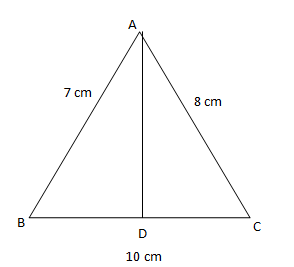
In ΔABC, AB = 7 cm. BC = 10 cm, AC = 8 cm. If AD is the angle bisecto…

In ΔABC, AB = 7 cm. BC = 10 cm, AC = 8 cm. If AD is the angle bisector of ∠BAC, where D is a point on BC, then $\frac{DC}{4}$(in cm) is equal to:

Answer & explanation+

Correct answer: option 2

AD is the angle bisector of \(\angle\)BAC

So, \(\frac{AB}{AC}\) = \(\frac{BD}{DC}\)

⇒ \(\frac{7}{8}\) = \(\frac{BD}{DC}\)

⇒ 88D = 7DC

⇒ BD = \(\frac{7DC}{8}\)     ..(1)

 Here, BD + DC = BC

⇒ \(\frac{7DC}{8}\) + DC = BC = 10 [As, BD = \(\frac{7DC}{8}\)]

⇒ \(\frac{15DC}{8}\) = 10

⇒ DC = 10 x \(\frac{8}{15}\) = \(\frac{80}{15}\) = \(\frac{16}{3}\)

Therefore, \(\frac{DC}{4}\) = \(\frac{4}{3}\)

Advertisement

Practise more on Quantitative Reasoning

Chapter-wise mocks on the real NTA exam screen, with solutions and your rank. Your first mocks are free.

Start free mocks →

Advertisement

Next questions

  1. Vijay bought a fridge and a washing machine together for ₹38,200. He sold the fridge at a profit of 15% and washing machine at a loss of 24…General Aptitude Test · Numerical Ability
  2. The product (X) is:Chemistry · Organic: Aldehydes, Ketones and Carboxylic Acids
  3. If a : b : c = 2 : 3 : 7, then what is 2a : 3b : 7c ?General Aptitude Test · Numerical Ability
  4. An Indian exporter sells 2,000 garments to a buyer in the USA. Other things remaining the same, what is the effect of this on India’s balan…Economics · Macro Economics: Open Economy Macro Economics
  5. Assertion: Fundamental rights are enforceable only against the State. Reasoning: Article 32 provides the right to the aggrieved ones, whose…Legal Studies · Human Rights in India
  6. Assertion: Stock Exchange enables investors to know the true worth of their holdings at any time. Reasoning: Stock Exchange publishes price…Entrepreneurship · Resource Mobilisation
  7. An electron has a circular path of radius 0.01 m in a perpendicular magnetic induction 10^-3 T. The speed of the electron is nearlyPhysics · Moving Charges and Magnetism
  8. Which of the following are not true?Economics · Indian Economic Development: Infrastructure
  9. 'Starting and maintaining an exercise habit' is reflective of which kind of personality traits.Psychology · Meeting Life Challenges
  10. If 5sin2A + 3cos2A = 4, 0° < A < 90° find the value of sin2θ + sec2θ + cotθGeneral Aptitude Test · Quantitative Reasoning