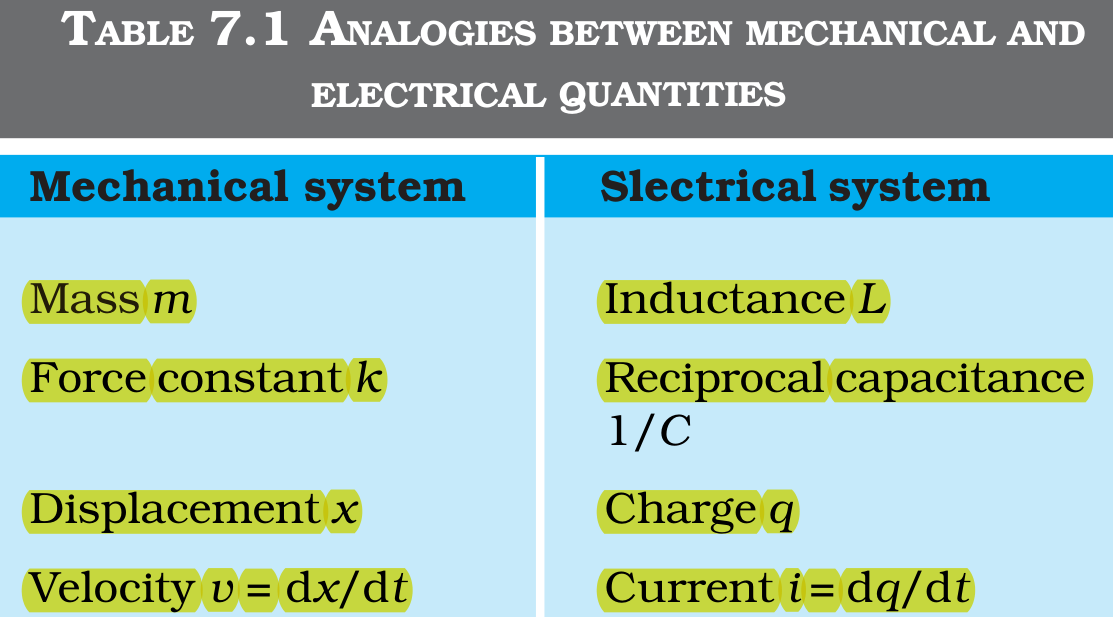
List I contains physical quantities related to mechanical oscillations of a block of mass m attached to spring of force constant k. List II contains physical quantities related to a LC oscillator.
Match List I with List II:
| LIST I | LIST II |
| A. Mass m | I. Charge q |
| B. Force Constant k | II. Inductance L |
| C. Displacement x | III. Reciprocal capacitance 1/C |
| D. Velocity \( V = \displaystyle\frac{dx}{dt} \) | IV. Current \( i = \displaystyle\frac{dq}{dt} \) |
On the basis of analogies between mechanical and electrical quantities.
Choose the correct answer from the options given below:
Answer & explanation
Correct answer: option 1
The correct answer is Option (1) → A-II, B-III, C-I, D-IV
The equation of motion of the block and the equation of the LC circuit have the same form, so the quantities in the same places correspond:
\( \displaystyle m\,\frac{d^{2}x}{dt^{2}} + k\,x = 0 \qquad\longleftrightarrow\qquad L\,\frac{d^{2}q}{dt^{2}} + \frac{1}{C}\,q = 0 \)
The energies match in the same way: \( \frac{1}{2}mv^{2} \leftrightarrow \frac{1}{2}Li^{2} \) and \( \frac{1}{2}kx^{2} \leftrightarrow \frac{q^{2}}{2C} \).
(A) Mass m — this matches (II) Inductance L. Both stand in front of the second derivative and represent inertia (kinetic energy \( \frac{1}{2}mv^{2} \) and magnetic energy \( \frac{1}{2}Li^{2} \)).
(B) Force Constant k — this matches (III) Reciprocal capacitance 1/C. Both multiply the displacement-like quantity and store potential energy (\( \frac{1}{2}kx^{2} \) and \( \frac{1}{2}q^{2}/C \)).
(C) Displacement x — this matches (I) Charge q. Both are the quantity that oscillates.
(D) Velocity \( V = dx/dt \) — this matches (IV) Current \( i = dq/dt \). Each is the rate of change of the oscillating quantity.
Note: This question is from the pre-rationalised NCERT book (2022-23). The topic was removed from the latest NCERT book (2026-27), and it also appears to be out of the CUET 2026 syllabus.
NCERT (Pre-rationalised edition, 2022-23):
LC Oscillations – …